Decision Table Interpretation
Rules inside decision tables are processed one by one in the order they are placed in the table. A rule is executed only when all its conditions are true. If at least one condition returns false, all other conditions in the same row are ignored.
Blank parameter value cell of the condition is interpreted as a true condition and this condition is ignored for a particular rule row or column. If the condition column has several parameters, the condition with all its parameter cells blank is interpreted as a true condition.
Note: As OpenL Tablets returns the first true condition, it is a good practice to list all possible non-blank parameters and their combinations in case of multiple conditioning first, and then list the blank parameters.
Blank parameter value cell of the return/action column is ignored, the system does not calculate the return/action expression of the current rule and starts processing the next rule. If the return/action column has several parameters, all parameters cells need to be blank to ignore the rule.
If the empty return value is calculated by the expression, the system starts processing the next rule searching for a non-empty result.
The following example contains empty case interpretation. For Senior Driver, the marital status of the driver does not matter. Although there is no combination of Senior Driver and Single mode, the result value is 500 as for an empty marital status value.
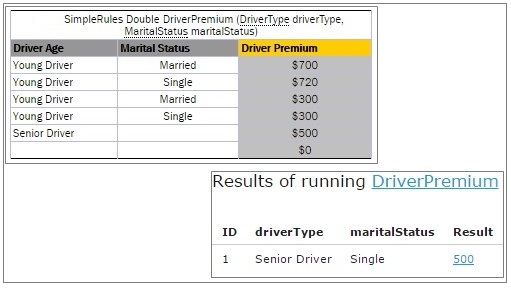
Empty case interpretation in the Decision table