OpenL Tablets 7.0.0 Release Notes
Contents
OpenL Tablets 7.0.0 opens OpenL Studio to AI agents. The MCP server now ships inside OpenL Studio and answers at
/mcp, so an agent works with OpenL projects under the rights of its user and gets the reference guides and OpenL
skills of the same release. The user guides ship inside OpenL Studio too, and the last JSF screens — the rules editor,
its toolbar, Test, Run, Benchmark and Compare — are rebuilt in React.
Rules authors get one table style that shows what each table takes and gives, written into the Excel files on every save, and a Sync that merges Excel workbooks table by table, row by row and cell by cell instead of asking which whole file to keep. Administrators get an audit log of sign-ins, access changes, project activity and settings, and Managers grant access to the projects they manage.
The rules language becomes predictable across countries: numbers lose the $ sign and octal notation, Double
arithmetic computes with the decimals the numbers show, and locale-dependent functions are removed. This is a major
release: the OpenL Studio API is served only under /rest, projects are addressed by stable ids, Groovy moves from
4 to 6, and the WAR files are released on GitHub instead of Maven Central. Review the breaking changes before
upgrading.
Highlights
- An MCP server built into OpenL Studio lets AI agents read, change, test, trace and deploy rules for their user.
- One OpenL table style formats every table by what its cells mean, on screen and in the Excel files on save.
- Sync merges Excel workbooks by table, row, column and cell, and resolves text conflicts line by line in place.
- An audit log records sign-ins, access changes, refused requests, project activity and settings changes.
- The user guides ship inside OpenL Studio and are searchable without internet access.
- OpenL Studio runs entirely on React; JSF and RichFaces are gone.
Doublearithmetic computes with the decimals the numbers show:0.1 + 0.2is0.3.- Projects and tables keep stable ids across renames, branch switches and restarts.
New Features
Built-in MCP Server
OpenL Studio carries an MCP server and serves it at /mcp of its own address. AI agents and IDEs, such as Claude
Code, Visual Studio Code with GitHub Copilot, Cursor or Codex, connect to it over the Model Context Protocol and work
with OpenL projects for their user: they find projects and tables, read and change rules, run tests and tables, step
through a trace, work with branches and merges, and deploy projects.
- The server is a Node.js program that OpenL Studio starts and stops with itself. The OpenL Studio Docker image
carries Node.js, the DEMO package downloads it, and a WAR deployment runs the server when Node.js is on the
PATH. - An agent sends a personal access token of its user as
Authorization: Token <token>and sees and changes only what this user can. Single-User mode needs no credentials, and inoauth2mode an access token of the identity provider is accepted asBearer <token>. - The server speaks MCP
2026-07-28and still serves clients of the earlier versions, such as2025-11-25. - The server reports the version of OpenL Studio and offers the reference guides and the OpenL skills of the same
release —
planning,branching,testing,versioning,trace-investigationandchange-log-and-reapply— through the MCP skills extension. - Large and binary files, such as Excel modules, travel outside the model. OpenL Studio issues short-lived transfer
links with
POST /rest/transfer-links, and a script of the agent downloads or uploads the file at/transfers/<id>without holding a token.
mcp.enabled = true
mcp.node = node
transfer.link.ttl = PT15M
transfer.max-pending = 20
Rules Editor Inside Projects
The Rules Editor is no longer a JSF tab of its own: a module opens from the screen of its project in Projects, its tables are listed as soon as that module compiles, and every table is read and written through the REST API. With it, the last pages drawn on the server are gone — JSF, RichFaces, CDI and JSP leave OpenL Studio, and every address answers with the React application.
- Run, Trace, Test and Benchmark open React panels under their toolbar buttons, and their results show every value with one viewer; Run into File and Trace into File download the results.
- Compare Excel Files, the comparison of two versions of a module in Local Changes, of a project with one of its revisions and of the versions of a conflicted file open one React comparison window over a REST API.
- A cell edit, its styling and the rows and columns inserted or removed are saved in one request that compiles only the changed module, and each message points at the cell it is about.
OpenL Table Style
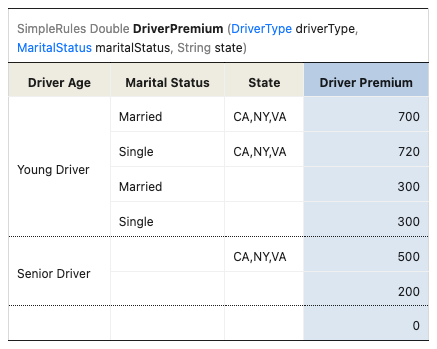
Every table gets one look, the OpenL table style, that shows at a glance what the table is, what it takes and what it gives. A cell takes its look from what it means in the compiled table — signature, properties, titles, conditions, returns, values — never from where it stands, and the style uses only what Excel offers: the theme colours, the theme fonts and the built-in cell styles, so a formatted file looks the same in Excel and follows the theme of the workbook.
- Format tables on save (
table.format-on-save, on by default) formats every table saved, created or copied, every.xlsxfile uploaded into a project and every workbook a merge of branches combines. Turn it off for teams that format their tables by hand. - Reformat Excel files in the More menu of the editor formats every table of the project at once.
- The Excel Formatting switch of the theme menu draws a table as its Excel file formats it; off, the table is drawn in the look of OpenL Studio, with formulas highlighted as code and values coloured by their type.
Formatting keeps the value, the number format, the indent, the wrapping and the rotation of every cell. .xls files
are not formatted.
table.format-on-save = true
Excel-Aware Sync and Merge
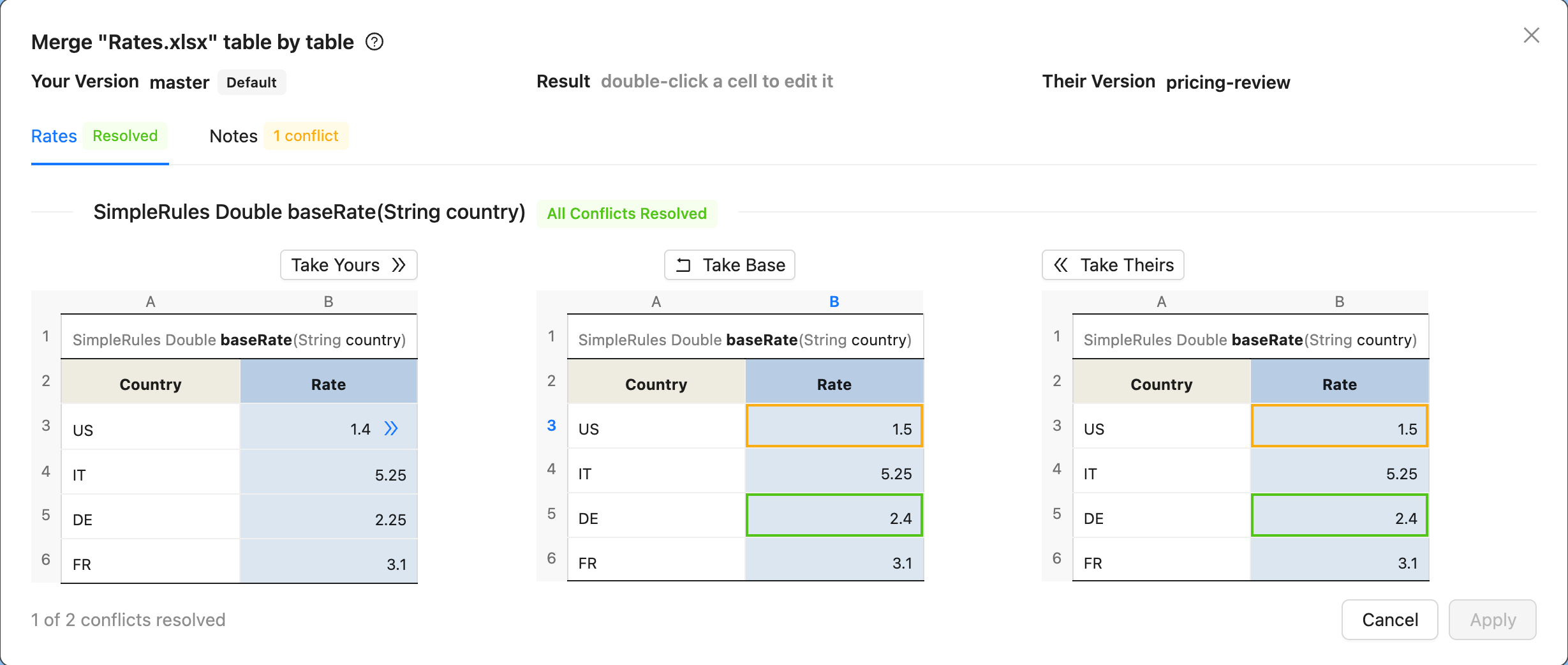
Sync no longer sends a workbook to manual resolution only because both branches changed the same sheet. A sheet changed on both sides is merged cell by cell when no side shifts its content, and otherwise table by table and row by row: rows, columns and tables one branch inserts, deletes or moves are taken from it, and rows or columns both branches insert at the same place of a table are all kept, those of the branch merged into first. Only cells changed differently on both sides, or a combination that could put a change in the wrong place, remain a conflict.
- Saving a project over the save of another user in the same branch combines the two changes the same way.
- A remaining conflict is resolved in the Resolve Conflicts dialog: a workbook table by table, each table taken whole from one version or merged cell by cell, and a text file line by line, with your version, the result and their version side by side. The MCP server resolves conflicts the same way.
- Compare File Versions compares a conflicted file with the base, the version both branches started from, in three views: Their Changes, Your Changes and Both Versions.
- The merge revision names each sheet combined from both branches.
Stable Project and Table Ids
A project and a table keep their id through the changes that used to replace it. A project id is 13 upper-case
characters computed from its repository and folder, so it survives a rename in rules.xml, a branch switch, an open, a
close and a restart. A table id is 16 characters computed from its workbook, kind and name, so it survives the table
moving on its sheet, a row or column inserted above it and a merge.
- While the server runs, the old id of a project moved outside OpenL Studio, of a renamed table or of a table whose
module file moved still serves it and names the new id in
Content-Location; the id of a deleted project or table answers410 Gone. - Two projects with the same name keep separate ids, and a table has the same id in every copy of its project.
Audit Log
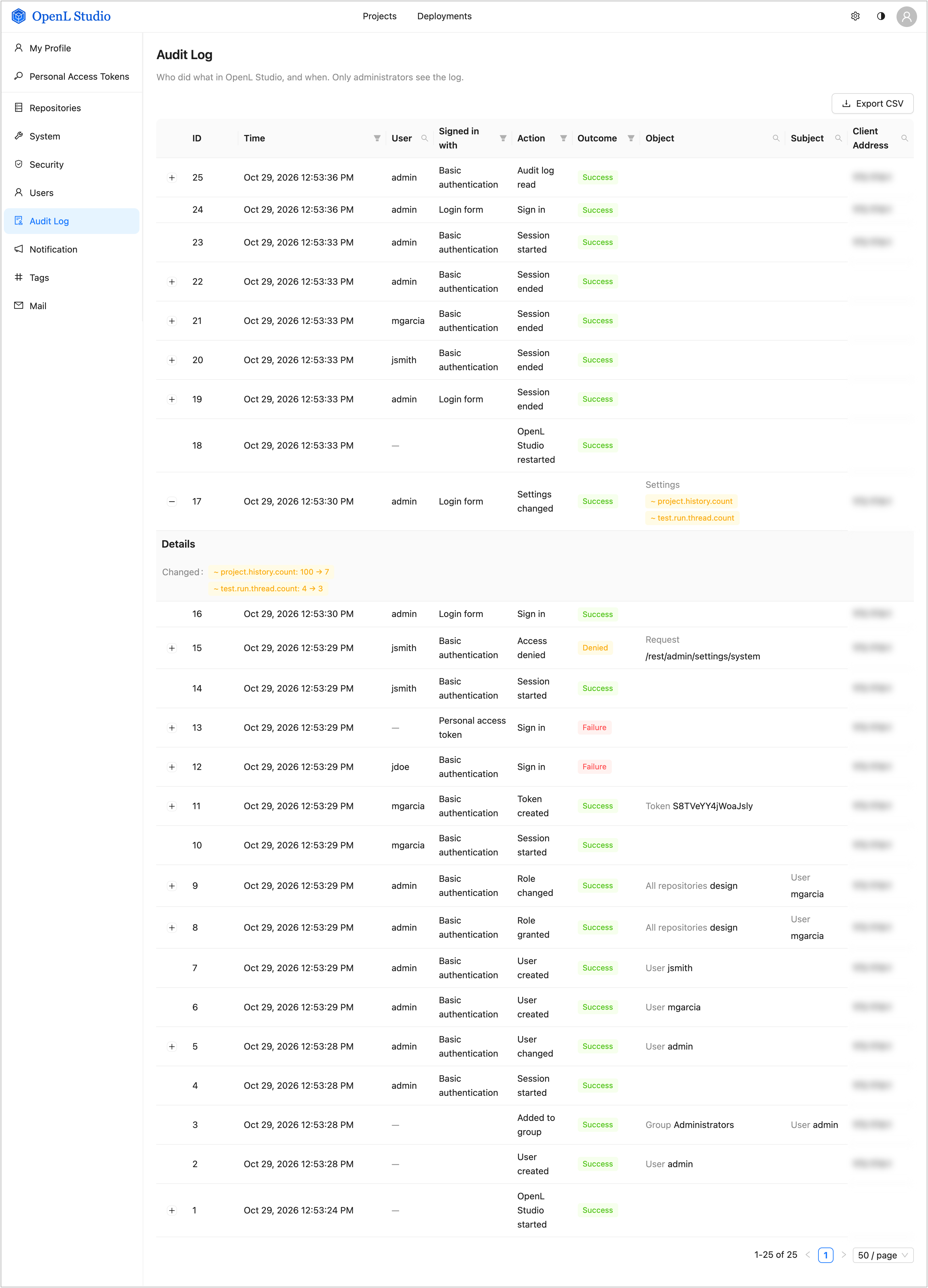
OpenL Studio keeps an audit log in its database in every user mode but Single-User. It records who signed in, whose sign-in was refused, who signed out and which sessions ended without a sign-out; changes of users, groups, personal access tokens and roles, including the roles a user gains or loses through the groups of an identity provider at sign-in; requests refused for lack of permission; project, branch and deployment activity; changes of the system settings and of the settings a deployment adds, changes or removes between starts; the starts, restarts and stops of OpenL Studio; and the reads of the log itself.
- Administrators open the Audit Log from the navigation menu, filter the events and export them as CSV. A change is shown as a diff, and the value of a secret setting is never recorded.
audit.retentionkeeps the events for a period, such as90d,6morP1Y6M, and keeps them forever when empty. It is also set on the System page.audit.outputs.consolealso writes every event to the console through theOpenL.auditlogger, for a log collector to pick up.- The events are read with
GET /rest/admin/audit, as a page of JSON or astext/csv.
audit.retention =
audit.outputs.console = false
Project Access Managed by Managers
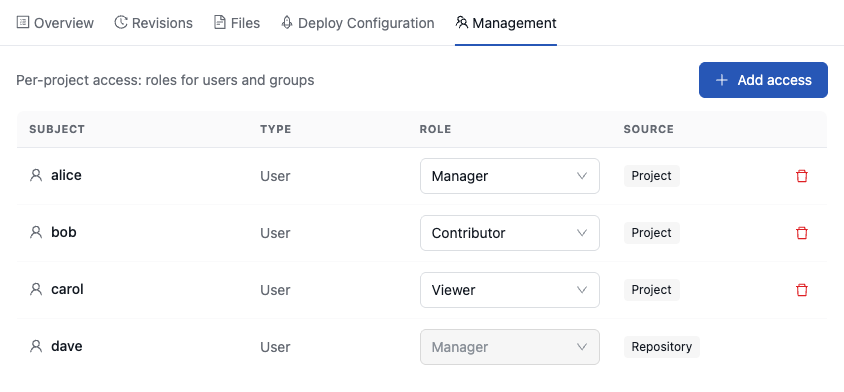
A user with the Manager role on a project or on its repository grants, changes and revokes the Viewer, Contributor and Manager roles of other users and groups on that project in its new Management tab, without involving an administrator. A change takes effect on the next request of the user. A role inherited from the repository is listed read-only, and a Manager cannot change or revoke their own role.
Embedded User Guides
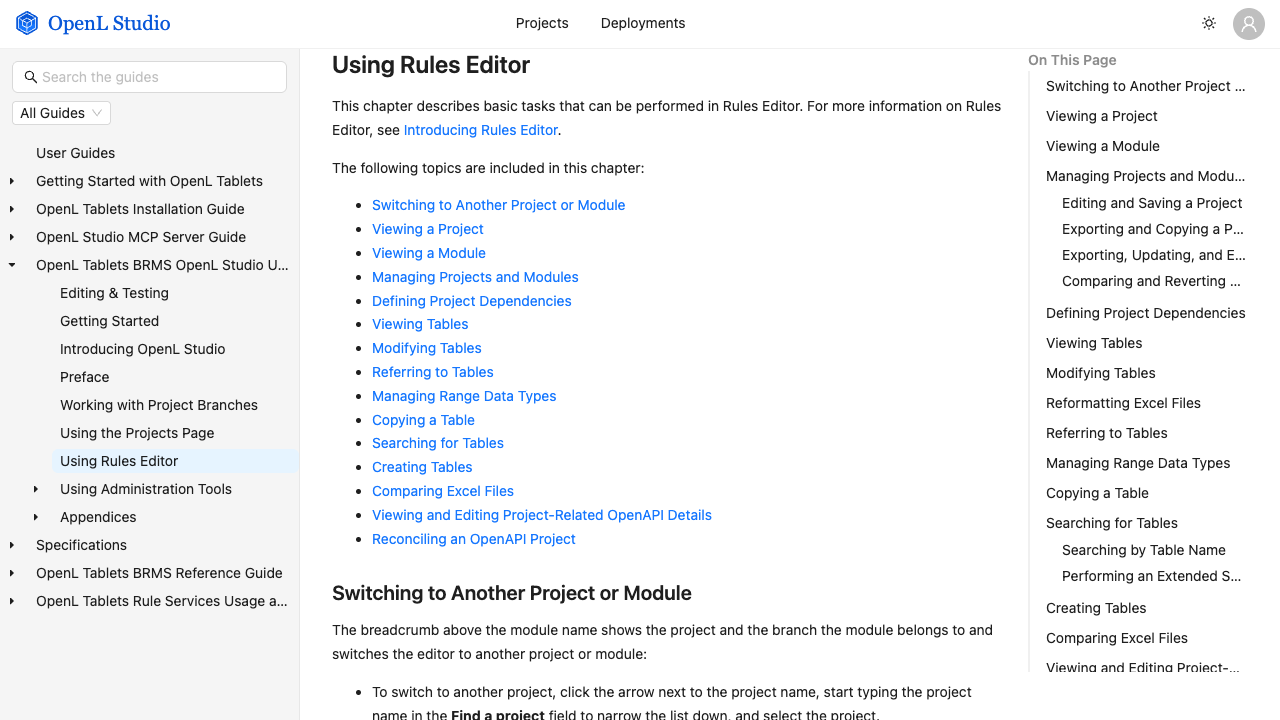
OpenL Studio ships the user guides of its own version and shows them inside the application at /docs, so they are
available without internet access and always match the running release. The Documentation card of the Help page
opens them. The viewer shows the table of contents, the page and its outline, draws Mermaid diagrams, highlighted
code, CSV tables and OpenL tables in the grid of the table editor, and searches the full text of all guides, one guide
or one section. The specifications of the project files are served at /docs/ref.
Appearance Themes
OpenL Studio follows the light or dark appearance of the operating system, and a switch beside the avatar in the header turns on the opposite one. A compact density fits more rows and fields on a screen, and besides the standard Ant Design colours the user picks one of 13 colour themes of well-known code editors, such as Dracula, Solarized, VS Code, GitHub, Monokai and Nord, each in a light and a dark variant.
- Every screen takes its colours from the theme, the login and error pages and the table dependency graph included, and the theme also paints the code editor of project files and the code samples of the embedded user guides.
- Workbook tables keep the colours of Excel in any theme, so a filled cell stays readable on a dark page.
Projects Edited in Place in Single-User Mode
In single-user mode with a design repository on the file system, OpenL Studio edits the projects right in their folders: there is no Open, Close or Save, and the edits made in OpenL Studio, its MCP server, Excel and an IDE land in the same files. When a file changes outside, the editor shows that the project changed, with Refresh, and the MCP server compiles the project again before a tool reads it.
- A workbook changed on disk since it was read is not saved over (
409), a file another program holds open answers423naming it, and the version another program saved is kept in the local history before it is overwritten. - In every mode, a table or a file is read with its version in
ETag, and a write that names an older version inIf-Matchanswers412 Precondition Failed; the editor always names it, and the MCP server requires it for every change of an existing table or file. - Files are written whole, so Excel, an IDE or OpenL Rule Services never read a half-written file.
Project Tags on the Overview Tab
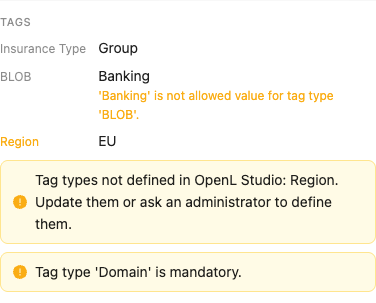
The tags of a project are shown and edited on its Overview tab and saved to tags.properties. A tag whose tag type
is not defined in OpenL Studio is shown in the warning colour and can be edited or deleted.
- An administrator arranges the tag types by dragging their rows on Administration > Tags, and the Overview tab lists the tags in that order.
- The Tag Types and Values screen lists the tag types and values that projects carry but OpenL Studio does not define, with the number of projects, and adds them in one click; a value opens the Projects list filtered by it.
PUT /rest/admin/tag-config/types/ordersets the order, andGET /rest/admin/tag-config/tagsandPOST /rest/admin/tag-config/tagslist and add the tags found in projects.
Improvements
OpenL Studio Editor
- Added text marks to table cells: a selected part of a cell text is marked Error, Warning, Success or
Info from the table toolbar, shown bold in the functional colours of the theme, and saved in the workbook as
bold rich text in a standard Excel colour, without changing the cell style or how the table compiles; the table
actions API takes them as
marksof a cell update. - Changed Test, Run and Benchmark to open their results straight in a separate browser window, as Trace does, instead of a dialog over the editor. All results share one window, which the next result reuses and brings to the front, and a long run can be stopped without holding the editor.
- Improved the Create Table dialog to read the types it offers from the compiled project, the types of dependency
projects included, through the new
GET /rest/projects/{projectId}/types, instead of rebuilding them from the sources of the tables it can see. - Improved the Basic trace view to show every call of a finished trace at any depth: the first view lists the upper levels whole, a deep branch loads from the tree kept after the run when it is expanded, and a step lists its calls 100 at a time, where the tree used to stop at 50,000 calls.
- Improved the table editor to keep the table actions bar and the edit toolbar in view while a long table scrolls, so rows and columns are inserted and removed without scrolling back to the top.
OpenL Studio User Interface
- Moved My Settings into a header menu beside the theme icon, grouped into Table, Testing and Trace settings that apply at once and are kept in the browser, and listed Personal Access Tokens in the user menu.
- Added an About dialog to the user menu that shows the OpenL Studio version and lists the frontend and backend
third-party libraries and the server software of the Docker image, with their versions, licenses and
LICENSEandNOTICEfiles. - Added links to a project,
/projects/{projectId}, and to a table of a module,/projects/{projectId}/modules/{moduleName}?table={tableId}, which open on a cold load, offer Open for a closed project and draw the linked table once its module compiles. - Improved the Create project dialog to show a validation or server error inside the dialog and keep the entered data, instead of closing and losing it.
Projects and Repository
- Added the
repository.ignored-pathssetting, Ignored Paths in the System section, which hides build, version control and CI files such aspom.xml,.gitignoreand the.githubfolder from users, keeps them out of exports and deployments, protects them from changes, and counts a revision that changes only them as technical. The.gitfolder is always ignored. - Improved the Projects tab to show only the projects of the default branches until a branch is picked in the
Branch filter, made the Tree view show the projects the Filters view selects, and added Clear
filters to both;
GET /rest/projectsmarks such projects withinDefaultBranch. - Added the
project.detect-by-excel-filessetting, Detect projects by Excel files in the Projects section of the system settings, cleared by default, so a folder with an Excel file but norules.xmlis no longer listed as a project; a project created from Excel files, a ZIP archive, an OpenAPI file or a demo gets a standardrules.xmlwith its workbooks underrules/. - Removed the From workspace mode of Create project and its
POST /rest/repos/{repo-name}/projects/from-workspaceendpoint; a local project is exported as an archive and created from it instead. - Added warnings to the Tags section of the Overview tab for a mandatory tag type without a value,
Tag type '<tag type>' is mandatory., and for a value a non-extensible tag type does not allow,'<value>' is not allowed value for tag type '<tag type>'., without blocking the save. - Improved the tags editor of the Overview tab to open the whole list of tag types or values on click and narrow it case-insensitively while typing, still accepting a value outside the list.
- Added the
Example-4-Reference-Guideexample project with a tested sample of every table type, of the formula syntax and of the built-in functions, and compiled every demo project and ran its tests during the build; theorg.openl.rules.demojar ships inside OpenL Studio only and is no longer deployed to Maven Central. - Improved the project list to check permissions once per project instead of once per branch and to stop re-reading repository configurations, which made it take over ten seconds on an instance with about 320 projects in many branches.
- Improved the indexing of design revisions, which matches a deployment to the design revision it was built from, to hash a file unchanged between revisions once instead of in every revision; a first full index of a large Git repository took more than an hour.
- Improved OpenL Studio to write
rules.xmlandrules-deploy.xmlthrough an XML mapping of the descriptor instead of building their text by hand, so an edit on the Overview tab keeps the elements it does not manage.
Sync and Merge
- Added an estimate of conflicts to the Sync dialog: before anything is merged, each file both branches changed is marked Possible conflict or Merges by itself, and a note tells how many files may conflict.
- Improved every comparison of Excel files to line up the rows and columns of a table as a text comparison lines up lines, marking each as added, removed, changed or equal, to recognise moved tables, and to compare without compiling the module. One colour scheme marks the changes in every comparison, the Save dialog and Resolve Conflicts, a conflicted workbook is shown in three columns — yours, the base and theirs — and a revision of another branch is compared from the revision both branches parted at, as a pull request is.
- Added the files a revision changed to the Revisions tab, listed when the revision is expanded, each opening the Compare window, and a comparison of any two revisions of a project; the MCP server lists them too.
- Added to the Sync dialog the projects each direction changes, with their number of changed files, the projects added or removed and the files changed in both branches before the merge, and a summary by project after it, with Compare for each file and the sheets an automatically merged workbook took from each branch; the Save dialog lists the files a save commits, each comparable with the saved revision.
REST API
- Removed the duplicate
/webprefix of the OpenL Studio API: every endpoint is served only under/rest, and the WebSocket handshake moved to{context}/ws, which requires authentication. - Added
idof the new project to the answers of a project create,PUT /rest/repos/{repo}/projects/{name}, and a project copy,POST /rest/repos/{repo}/projects/{name}/from-project, and let a copy name its source by the project id alone. - Added the
tableIdparameter toGET /rest/projects/{projectId}/tests/summaryand its Excel export, which limits the summary to one test table; an id no test table of the run has answers an empty summary. - Extended the OpenAPI of OpenL Rule Services to publish the values of a vocabulary datatype wherever it is used: on the items of an array field instead of the array itself, in a spreadsheet result cell, for the only parameter of a rule and for its response; the Run and Trace form of OpenL Studio offers them as a list.
- Extended the OpenAPI import of OpenL Studio to generate a vocabulary datatype for every
enumof an OpenAPI file, and OpenAPI reconciliation to require a vocabulary datatype with exactly the listed values wherever the file declares anenum.
Rules Engine
- Added the index of the element to array index operators:
array[(element, index) <operator> <expression>], with optional types as inrates[(Double rate, Integer i) transform to rate * (i + 1)]; the index counts from 0 and every operator takes it, the short forms included. - Improved arithmetic on
Doublevalues to compute with the decimals the numbers show: the operators+,-,*,/,%,++,--and the functionsremainder,quotient,floorDivandmodround the exact result once, so0.1 + 0.05 - 0.03is0.12instead of0.12000000000000002. - Extended decision table condition indexing to a lookup of a column value in an input array, such as
contains(codes, code), several lookups over the same array, a lookup guarded by a static check joined byand, written as a ternary or testing that the array is empty, and a condition written as a call of a one-expression table, so such tables no longer evaluate their conditions rule by rule on every call. - Reduced the constrainer behind the
validateDTgap and overlap check of decision tables to the part the check uses and joined it intoorg.openl.rules; the check now reports the smallest input of a table without rules as uncovered and handles a condition domain of 2^31 values or more, where it threwArrayIndexOutOfBoundsExceptionorNegativeArraySizeException. - Improved
sum,avgandproductofDoublevalues to round the exact total once instead of after every value, sosum(0.1, 0.2)is0.3. - Restored
%and**as short forms ofremainderandpow, and theK,MandBmultipliers in formulas, with exact values; a comma groups thousands in number cells and formulas only between groups of three digits.
MCP Server
- Moved large and binary project files out of the agent context:
openl_read_project_fileanswers a text of up to 5,000 bytes inline and any other file, or a folder as a ZIP archive, as a download link with a readycurlcommand,openl_create_upload_linkanswers a link that uploads a file, and no tool carries base64; OpenL Studio issues the links throughPOST /rest/transfer-links. - Improved the tool descriptions that agents misread: the
idlecompile state ofopenl_list_projectsandopenl_get_project, the module edit history ofopenl_list_project_local_changes, andsummary.afterofopenl_merge_project_branchesas the new revision of the target branch. - Aligned the arguments of sibling tools:
openl_set_trace_breakpointstakesbreakpoints, asopenl_start_tracedoes, andopenl_run_tableacceptsinputJsonas a JSON string as well as an object.
Maven Plugin and Distribution
- Added
openl:migratesteps for the changes of 7.0.0:rules.removed-functionsrewrites the calls of the removed functions such asformat,dateToString,stringToDate,parseFormattedDoubleandaddIgnoreNull,rules.currency-signremoves the$sign from numbers,config.deploy.jackson-typingreplaces the removed Jackson typing settings inrules-deploy.xml, andgroovy.generic-staticandgroovy.removed-mathadapt Groovy code to Groovy 6 and to the math functions removed fromRulesUtils. - Deprecated the
deploymentNameparameter of thepackagegoal: the deployment archive is always<finalName>-deployment.zip, and the newpom.unused-parametersstep ofopenl:migrateremovesdeploymentName,deploymentPackageand the parameters no goal declares frompom.xml. - Reduced the number of published Maven modules: the table editor, the security and the Spring OpenAPI modules are
joined into the OpenL Studio backend,
studio-backend, and the WARs are released on GitHub asopenl-studio.war,ruleservices.warandruleservices-all.war.
Administration and Observability
- Stopped tracing every Hibernate and JDBC call in the OpenL Studio and OpenL Rule Services Docker images by default,
which made the collector hang;
OTEL_INSTRUMENTATION_HIBERNATE_ENABLED=trueandOTEL_INSTRUMENTATION_JDBC_ENABLED=truebring the spans back. - Added the
security.password.encodersetting:bcrypt, the default, ornoop, which keeps passwords and token secrets in plain text for integration tests and logs a warning at startup; any other value stops OpenL Studio. - Added OpenTelemetry traces and metrics to the OpenL Studio pages and the built-in MCP server, driven by the same
OTEL_*environment variables as the Java agent of the backend; the pages send them through the/rest/telemetryrelay, so the collector need not be reachable from browsers, and a request is one trace from the page or the MCP client to the backend. - Improved the list of groups of a user in the administration to collapse again after it is expanded.
Documentation
- Removed the deprecated Method, TBasic, ColumnMatch and TablePart tables from the Reference Guide, the tutorials and the examples, which teach the current table types instead.
- Documented that a test of a
Doubleresult without a precision allows a difference of one ULP of the actual value, and howroundtreats an empty scale and an empty rounding mode.
Bug Fixes
Rules Engine
- Fixed a lexical error on names written in Korean and other scripts, caused by fixed Unicode ranges of the characters an identifier may hold.
- Fixed
Doublearithmetic returning binary approximations such as41.251499999999986that failed a test expecting41.2515: the operators and functions onDoublevalues now compute with the decimals the numbers show. - Fixed
null + 3andnull - 3returning an emptyDateinstead of3and-3, which also reported a misleadingCannot convert from 'java.util.Date' to 'java.lang.Integer'.next toIdentifier '...' is not found.: the literalnulladded to or subtracted from a number now takes the type of the other operand. - Fixed a one-dimensional array not being converted to a two-dimensional one in a Rules table, which failed with
Cannot convert from 'MyDatatype[]' to 'MyDatatype[][]'. - Fixed a missing error for two datatypes with the same name and package in a project and in the project it depends on:
the module now reports
Duplicate type definition: MyDatatype. - Fixed a missing error for an unidentified variable in a Spreadsheet cell, lost when another table compiled that cell first.
- Fixed the error
Field 'null' is not found.for a dotted field name in a named-argument constructor, such asnew MyType(intFiel.d = 5): the error now shows the field name. - Fixed
new Customer(name = name)leaving the fieldnull: a named constructor argument read the field of the new object instead of the rule parameter. - Fixed
new Customer(city = city, name = name)swapping the fields and overwriting the rule parameters, caused by named arguments afternewbeing passed to a positional constructor. - Fixed the error
The element is null.for a Spreadsheet returning a single value when no step has a name: the problem is now reported asThere is no step to return: no step of the Spreadsheet has a name. - Fixed a Spreadsheet section caption, a row merged across the table, becoming a result step holding its own text: it no
longer appears in the
SpreadsheetResultfields, the OpenAPI schema or the response. - Fixed an external action not being matched with the last column of a SmartRules table of the
voidtype without a return column, which failed withCannot parse cell value 'T1'. Expected value of type 'void'. - Fixed a SmartRules table overwriting the values set explicitly in its return column with input parameters of the same name.
- Fixed the empty key error and the
Foreign table has errorserror caused by columns a merged header added to the size of a Data or Test table. - Fixed
CompositeMethod cannot be cast to Comparablefor a formula in the upper bound of a two-column range condition, which was taken for a table of constant values and indexed. - Fixed a condition over an alias column failing with
OutsideOfValidDomainExceptionfor a value outside the alias only when the condition was indexed: such a value now matches no rule, with or without an index. - Fixed SmartRules and SimpleRules conditions over
BigIntegernever matching a whole-number cell beyond theintrange or a range list, and conditions overLongcomparing the values asdouble, so a neighboring value above 2^53 matched the wrong rule. - Fixed a
DoubleRangecondition such as> 10not matchingInfinity, and a negative bound such as-1taking the number next to it on the wrong side. - Fixed
0.5%and12.345%failing to compile with a lexical error, and0.07%being7.000000000000001E-4in a formula and in aDoublecell: a percent literal now accepts any number of decimals and is exact. - Fixed
250%in aLongcell loading as2and5%in anIntegercell as0: such a text now fails with a parse error. - Fixed a text cell
1.5e3failing withCannot parse cell valueandtoNumber("1.5e3")returning an empty value: a number with a lowercaseeexponent is now read as the one withE. - Fixed dates in text cells not being read: a date without time into
LocalDateTime, a US time after noon and a US day of one digit failed withCannot parse cell value. - Fixed
new DateRange("2019-03-12")and a text cell2024-12-25 00:00:00in a SmartRules or SimpleRulesDatecondition failing to parse: a date range now reads ISO dates besides the US form12/31/2024. - Fixed
toDateignoring the text after a date, so thattoDate("2024-03-06-01")returned03/06/2024instead of an empty value,toDate(text, "")reading only the US form,like("", "*")returningfalse,@matching onlyA-Zinstead of any letter, andtextSplitmissing a separator that starts inside an earlier partial match. - Fixed
transformevaluating the null elements of an array thatorder by,split byandselectskip:transform toandtransform unique tonow skip them too. - Fixed
transform uniquefailing with aNullPointerExceptionwhen the array or the collection is missing, such as the values of a missingMap. - Fixed array index operators failing with
array element type mismatchwhen the declared element type differs from the actual one, such asORDER BYover an array,SELECT ALLandSPLIT BYover a list;ORDER BYover an array now returns the original elements in the new order. - Fixed the array functions changing the type of the array:
removeElement,slice,removeNulls,sortandaddElementturnedint[]intoInteger[],addcut2.5to2in anint[],flattenof anint[][]failed andremovefailed on a missing array. - Fixed
min,small,bigandmedianrankingNaNabove every number: they now returnNaNwhen one of the values isNaN, asmaxdoes. - Fixed
round(5000000000.4, DOWN)wrapping around to705032704andround(16777217, 0)returning1.6777216E7: the rounding mode now caps at theIntegerlimits asround(x)does, and a whole number is no longer rounded as aFloat. - Fixed
absnot compiling forBigDecimalandBigInteger, and the math functions reading an empty argument as0, such assqrt(v)being0andcos(v)being1: they now return an empty value. - Fixed a test of a
BigDecimalresult passing with a wrong digit after the 16th because both values were compared asDouble: the values are now compared with all their digits. - Fixed a rule called by its id failing with
No matching methodswhen Dispatching Validation is on: an alias created by theidproperty is no longer wrapped in a dispatcher. - Fixed the slow array and range arguments of a function call, such as
product($F1:$F5): array elements are no longer read and written through the nativeArray.getandArray.set, so an array call is within a few percent of a varargs call. - Fixed conditions mixing enumeration and range values, such as
1,2and3-5, returning nothing without a message because1,2was read as the number 12. - Fixed numeric cells beyond the
intrange not being read intoLongandBigIntegervalues, which causedCannot parse cell value '2.147483648E9'in Test and Data tables and wrong rules being selected for such arguments.
Rules Editor
- Fixed cell editors behaving differently across browsers, with a cell of a test table keeping its focus and the Save button staying disabled in Chrome.
- Fixed special characters such as
',,,;,:and=breaking the editing of a numeric cell, and decimals not being enterable until the page was refreshed. - Fixed the
Typeof a Datatype field not being a link when theTypecolumn is not the first column. - Fixed an error shown for a Method table body pointing at the wrong row when a row holds several lines, and nothing being marked in a body of several rows.
- Fixed the “Sorry, page not found” page appearing when switching between the modules of a project whose folder name
differs from the name in
rules.xml. - Fixed the expanded state of the project tree leaking between projects.
- Fixed range editors missing for Smart Lookup conditions that have usages, so numeric ranges in horizontal conditions can be edited again.
- Fixed a datatype used as a value, such as a vocabulary passed to
getValues, not being underlined and linked to the table declaring it. - Fixed a datatype field bound to a context property losing the link to its type and the type of its default value.
- Fixed a table row whose cells all merge into the next one being displayed taller than a line, which broke the table layout in Chrome.
- Fixed the Editor menu panel being shown on the project page when a sync removed the module that was open; the project page now opens cleanly.
- Fixed the cursor landing in the wrong place when clicking a Spreadsheet error in a table that has properties, because the properties shifted the error links.
- Fixed an NPE logged for every cell when a ColumnMatch table that does not compile was opened.
- Fixed the “The element is null” error on a Spreadsheet table whose own properties cannot be read; the default properties are now kept.
- Fixed an NPE and silently wrong keys when a title cell crosses the horizontal condition border, which showed an incorrect error.
- Fixed an
ArrayIndexOutOfBoundsExceptionin the hint of a constructor call with a wrong named argument. - Fixed an NPE in a multi-row test table of a rule overloaded without inputs, which showed “The element is null.” without saying what is wrong.
- Fixed the error for a duplicated input being reported for every cell bound to it; it is now reported once at the header.
- Fixed missing dependency graph links for tables called through varargs.
- Fixed Boolean cells holding
y,n,tandfbeing shown as typed instead of astrueandfalse. - Fixed inconsistent capitalization of Boolean values in the table view when the cells had different types in Excel.
- Fixed a table name made bold in Excel not being shown bold in the Editor.
- Fixed Double values below
0.001being shown in exponent format such as4.0E-4in the cell editor. - Fixed the year of a date being cut to two digits, such as
80instead of1980, after opening the cell editor and clicking away. - Fixed the date drop-down of an alias datatype offering two-digit years, so the chosen date was saved in a wrong century and failed validation against the alias domain.
- Fixed a missing drop-down and calendar for alias and Date cells in the first row added to an empty Data or Test table.
- Fixed the cell editor of a property added to a Properties table opening the list of the previous property, such as US States, instead of its own editor.
- Fixed the date picker being partly hidden, so a property such as
Countriescould not be added to a table in Google Chrome. - Fixed a property saved with its default value, such as
failOnMissset tofalse, not appearing in the table and in the Table Details panel. - Fixed a cell being cleared after editing when the cell below it contained an error.
- Fixed “Internal server error” shown instead of a clear message when a column cannot be inserted because the table reaches the last Excel column.
- Fixed the text selection being lost, and the cell editor or the Run panel closing, when the mouse is released outside the field during selection.
- Fixed the “Modified” field of a table being shown cleared after the table is edited from the search results.
- Fixed the cell editor showing browser console errors on editing fields.
- Fixed the cell editor showing the Include checkboxes of a range condition at different heights, one above and one below its field.
- Fixed the Reference Guide listing values of the Validate DT property that OpenL Studio does not offer; it lists
onandoff. - Fixed the hint of a table link being partly hidden behind the Table Details panel.
- Fixed a bold hint being shown when hovering a bold cell.
- Fixed no hint being shown for an argument of an alias datatype, and no hint for the default value of a property.
- Fixed a horizontal scroll on the Table Details panel when the table name or a property value is long.
- Fixed table toolbar buttons being scrambled when the table name is very long.
- Fixed a table title written in several lines being shown cut in the project tree, such as
b)instead of the table name. - Fixed module names in the project tree being split and shifted when they are long.
- Fixed the Editor menu panel breaking on macOS when the project name is long, and the Copy and Delete buttons in the project list wrapping into two lines in Safari.
- Fixed the Firefox log error “illegal character U+009E” on opening OpenL Studio.
- Fixed the table editor having no way back to the view mode after a double click: the editor now has a close button that returns to the table view.
- Fixed the editor keeping the user on a module page with a “Project is not found” error after the project is closed or unlocked in another session: the module page now shows an Open button and stays usable without errors.
- Fixed the error UI (red and yellow squares) flashing for a moment while a module without errors or warnings is opened.
- Fixed font and fill colors not being applied to a cell in the table editor in Safari.
- Fixed a freshly set font color disappearing when bold, italic or underline is applied after it.
- Fixed the “Load This Module Only” checkbox of the module editing form being changed by the keyboard while the mouse could not change it; the option is now an ordinary checkbox editable in both ways.
- Fixed a new empty row appearing under a Spreadsheet table after a table property is removed.
- Fixed the editor hanging with an endless loading indicator when a cell value exceeds the Excel limit of
32767characters: the editor now stays usable, showsFailed to save the table: The maximum length of cell contents (text) is 32767 charactersand leaves the table unchanged. - Fixed the Table Details panel disappearing after several properties are added one after another.
- Fixed the NullPointerException on rapid module switching through the breadcrumb, which came from the removed JSF module page.
- Fixed the Problems block not showing the error of a Spreadsheet table that has a properties row: the error location was shifted by the properties row and fell outside the table.
- Fixed the “Oops! Something went wrong.” page when a table is opened and some classes referenced by it are missing in
the project
*.jarlibraries: the table opens and the problems name the missing class. - Fixed a long project path being displayed incorrectly in Chrome, Safari and Edge: it now wraps over several lines.
- Fixed the inconsistent colors of the Run, Trace and Benchmark menus, which are now separate toolbar buttons.
- Fixed the UI becoming unresponsive after several test runs in multi-user mode.
Table Editing and Excel Files
- Fixed table edits being silently lost when two threads loaded the same workbook at once: the write answered success
but the change, such as an appended row or a deleted table, was absent from the
.xlsxfile. - Fixed the table style changing when a table is copied into another module: the colors of a header, rows and borders now stay as the source shows them.
- Fixed the copy table dialog offering the first sheet of the module instead of the sheet of the copied table.
- Fixed the copy table dialog not showing a date property of the source table, such as Effective Date or Expiration Date, because the date was carried in a locale-dependent format.
- Fixed Excel formulas keeping their old references after a row or column was inserted into a table, so a formula silently computed from another cell.
- Fixed a cell holding an Excel formula with an error result, such as
=D5/0, being read asunknown type: FORMULAinstead of#DIV/0!. - Fixed the table editor losing the fill of a cell when bold, italic or underline was applied to it, so the cell turned white or black.
- Fixed Excel formulas turning into plain values in a table copied with Copy or Copy as New Version, so the copy shows the formulas of the original.
- Fixed the Create Table wizard failing to advance from the step “Construct a table” for a Simple Rules table with several rows: the table is created in the Create Table dialog.
- Fixed the table write APIs accepting payloads that leave a blank row or column inside the table, which silently split the table, and a Data or Test table that titles none of its columns; such writes are now refused.
- Fixed
POST /rest/projects/{id}/tables/{tableId}/copywriting a property value that cannot be read as a date as text and answering 201 while the module stops compiling; the request is now refused. - Fixed a range or a boolean typed into a cell being saved in another notation, such as
2-5becoming[2..5]. - Fixed a full-table update rewriting cells it did not change, which turned their ranges into another notation.
- Fixed cells below deleted table rows being saved in another notation (
24as24.0), which produced hundreds of value-equal changes in diffs and merges. - Fixed adding columns or rows to a large table taking minutes: each inserted row moved every row below it, each appended row re-read the whole sheet and each last-column cell grew the table.
- Fixed saving a table taking minutes in a workbook with many named cell styles, caused by quadratic lookups of the OpenL styles on format.
- Fixed table copy writing a text that starts with
=as an Excel formula into the workbook, and the copy of a table with such an expression stopping with an endless loader: an OpenL expression is never written as an Excel formula, and the copy keeps the original cell text. - Fixed OpenL expressions such as
="A"being turned into Excel formulas in other cells when a table is edited and saved while theUpdate table propertiessetting is enabled. - Fixed the color of a table becoming grey after the table is copied to another module: the copy keeps the original cell styles.
- Fixed the
UnsupportedOperationException: Not supported formula typeerror in the log when a table with an Excel shared formula such as=RANDBETWEEN(1;1000)is opened. - Fixed creating, copying or moving a file of a closed project over
POST /rest/projects/:projectId/files/:path,file-copyandfile-movefailing with409andCommit author name is blank., and an overwrite or a deletion being committed under the previous author and message of the file; fixedrules.xmlstill declaring a module after its file was deleted from a closed project of a design repository. - Fixed whole numbers written into a cell being saved as
67.0instead of67, unlike the cells saved by Excel. - Fixed a table moved to grow having its untouched cells rewritten when saved: texts were trimmed,
1became1.0and the merged title was copied into every merged cell. - Fixed a text starting with
=, such as= product($F1:$F4), being saved as an Excel formula that the cell showed as0: an OpenL formula stays a text, and an Excel formula is written only when it is asked for. - Fixed tables created in one module at the same time failing with
500The module is not compiledor answered with an empty body: the project writes of one client are applied one after another now. - Fixed deleting a block of rows or columns across two merged groups of a table shrinking the first group by the whole
block and leaving the second one unfitted, which gave overlapping merges and
IllegalStateException.
Search
- Fixed “Oops! Something went wrong.” when a very long text was entered in the extended search fields, which ended in an HTTP 414; the fields are now capped.
- Fixed the advanced search keeping the old value of a property that was removed and added again.
- Fixed the property selector of the advanced search being empty after a property was added.
- Fixed the whole advanced search panel closing on Clear or Today in a date field.
- Fixed the advanced search panel closing on a click in the main search panel, and not reliably closing with its arrow.
- Fixed utility tables being listed in the search results when Hide utility tables is on.
- Fixed the Search results including special tables in an unstable order: all found tables, special ones among them, are now sorted A to Z, with names starting with a digit first.
- Fixed the search page failing with “Oops! Something went wrong.” when an unknown
searchScopeparameter is passed in the address line: the module opens without an error. - Fixed the search method being invoked when no search was performed: the Search dialog asks the server only when the user starts a search.
- Fixed the Advanced filter pop-up freezing after repeated use.
- Fixed missing and unexpected search answers of the removed Smart Assistant, such as none for the
randomfunction; the Extended search of the editor and the search of the user guides return the expected results.
Test, Run and Trace
- Fixed Run, Trace and Benchmark in OpenL Studio executing a nested JSON input with a value outside the vocabulary of an
alias: such a value is now refused with
Value '...' is outside vocabulary '...'. Allowed values: ...before the execution. - Fixed test cases being numbered per line, so a multi-row case took several numbers, and sub-objects of a multi-row test case landing in wrong elements; the multi-row records of Data and Test tables are now set apart by a line.
- Fixed a user error raised by a test case making the whole Spreadsheet result show as the expected value instead of the expected cell values.
- Fixed “Run into File” for tests producing wrong data for list inputs found by a primary key and shifted result columns.
- Fixed a JSON table run failing with
Cannot invoke "java.lang.Boolean.booleanValue()"whenisProvideRuntimeContextis missing inrules-deploy.xml. - Fixed a Spreadsheet result argument arriving empty in Run and Trace, which lost the populated input.
- Fixed the
POST /rest/projects/{projectId}/tests/runerrorobject.mapper.configuration.failed.messageshown without a readable text whenrules-deploy.xmlreferences classes missing from the project classpath; the missing classes are now named. - Fixed the Run and Tests REST APIs publishing a Spreadsheet result in a form a client cannot read; it is now written as a bean.
- Fixed
POST /rest/projects/{projectId}/tests/runacceptingtestRangeswithouttableIdand silently testing the whole project; the request is now refused. - Fixed
GET /rest/projects/{projectId}/tests/summaryreporting 0 failures, or 0 tests and N failures, when a test table or the rules it tests do not compile; such tables are now reported as not run, and every case of an uncompilable test table counts as a failed test. - Fixed Run, Trace and Run with a
runtimeContextexecuting a table, or a version of an overloaded table, that does not compile and answering HTTP 200 with a result worked out from the readable cells and no errors. - Fixed Trace failing with
is not valid JSONwhile Run showedStackOverflowErrorfor the same input: a deep recursion now keeps valid JSON, a stack overflow is parked at the root call, deep trace rows scroll into view, trace tree styles are read once instead of per row (which froze the tab), and an NPE in the REST error handler after the response was committed is gone. - Fixed “something went wrong” and an NPE when a
CustomSpreadsheetResulttype is chosen for an input value of a Run. - Fixed arrays being shown in the Run input in a different way than other collections.
- Fixed extra information shown in the input column of a test result for a
Listinput value. - Fixed the Run result showing always the first element of a Data table as input instead of the one used.
- Fixed an Internal Server Error when expanding a trace in which a datatype was passed instead of an element into another method.
- Fixed the traced Spreadsheet table being shown with default formatting and a color different from the original: the traced table keeps the colors, fills and fonts of the table in the workbook.
- Fixed the
Skip Empty Parametersoption being offered for Trace, where it has no effect. - Fixed Trace silently dropping input objects with an inherited field when
@classis missing in the JSON: the dialog now shows the errorCould not resolve subtype of AtomicType: missing type id property '@class'. - Fixed an error in the log when a test that consumes an extreme amount of memory is traced and the trace items are expanded.
- Fixed the Tree Form not being displayed for an input parameter of the
CustomSpreadsheetResulttype: the Run panel shows an editable form with the fields of the type. - Fixed the returned value being displayed in the
_error_column when a test returns no error: the column is empty and the value shows only in the result column. - Fixed the Run menu being unavailable for a table without input parameters: the Run panel opens and executes the table.
- Fixed the data of a
Collectionand aListinput being passed to the rule asnull: the Run form passes all entered elements.
Compare
- Fixed the Compare pop-up cutting the comments of the right table, and not showing the notes of the cells in Compare Excel files on the first comparison.
- Fixed an Internal Server Error in the Compare pop-up when the project was opened meanwhile, and an extra empty space that did not let the table preview be extended.
- Fixed Compare Excel files not accepting two files with the same name from different locations.
Projects and Repository
- Fixed a project Overview edit being saved automatically after an OpenAPI file was selected, and a deploy configuration edit being applied before its own Save; both are now kept until Save or Cancel.
- Fixed a filter group on the Projects page not being draggable to the end of the filters rail, because it was dragged together with all its values and only by a small grip.
- Fixed the Sources and OpenAPI sections of the project page and the Deploy Info section of the module page being pushed below a long list of methods, with a horizontal scroll, for a project created from OpenAPI.
- Fixed the Create Project dialog being corrupted, with misaligned fields and a scroll bar, at the screen resolution 3840x2160.
- Fixed the list in the Manage Dependencies pop-up scrolling together with its header.
- Fixed the module copy leaving the project list on the left instead of the module tree.
- Fixed saving a project of a
repo-filedesign repository replacing the project folder with the copy taken at open, which reverted changes made on disk, deleted new files and restored deleted ones: only the files changed in OpenL Studio are written now. - Fixed the project status of a
repo-filedesign repository listing every project file as a pending change after one edit and reporting files added or deleted on disk with the opposite type: only the files changed since the project was opened are listed now. - Fixed
GET /rest/projectsanswering HTTP 500Illegal base64 character 20whendependsOnheld a project name: it answers400now and says that a project id is expected. - Fixed a commit comment longer than 255 characters being refused with a bare
Length is greater than allowable maximum
of '255'
: the limit is now stated in the OpenAPI models and in the MCP tool schema, and the error names thecommentfield. - Fixed projects and repositories of the
repo-filetype requiring theREPOSITORY_EDT_COMMENT_TEMPLATE__REF_andREPOSITORY_EDT_NEW_BRANCH__REF_settings: a project is now saved and created without comment generation, and the history is not offered for a file repository. - Fixed the Save button being available for a local project.
- Fixed OpenAPI Reconciliation errors
Expected response is not foundandUnexpected response is foundfor the same media type written with and without the charset, such astext/plainandtext/plain;charset=UTF-8. - Fixed the horizontal scroll bar of the Help page, the main page of OpenL Studio.
- Fixed a copied project not linking its source project in the “Copied from” comment of a revision on the Revisions tab.
- Fixed a project copy into Git keeping the unsaved name of the source project, which failed the copy when Project Info was edited but not saved.
- Fixed the Resolve Conflict dialog not appearing and the save failing after a project was renamed, an old revision was opened and the project was renamed again.
- Fixed an unclear error when saving a project while the Design repository database is down; the message now names the repository that failed to store the project.
- Fixed an empty deployment (an empty
MANIFEST.MF) being left by the permission check of a changeset when the Design repository is a database and the Deploy repository is local or Git. - Fixed modules that are no longer needed continuing to load after a project was opened and closed quickly and a
dependent project with
autoIncluded = falsewas opened; only the dependency modules a project compiles are counted and the background compile of a replaced project is stopped. - Fixed a Windows local path, whose drive letter was read as a URL scheme, being rejected in the “Local path” field.
- Fixed an error creating a project when a file name contains a character such as
?; the error now names the file. - Fixed a project name containing
/or\showing “Something went wrong on API server!” instead of the name-validation message. - Fixed a project created from Excel files not placing them in the
rulesfolder. - Fixed navigation to a dependency project failing with “Not Found” on the Overview screen for local projects whose name differs from the project folder; dependencies are now resolved by logical name.
- Fixed an unfriendly full-page 403 screen when creating a project in a protected branch; the error now names the protected branch and the create dialog shows it.
- Fixed the exported project archive being named after a wrong revision and in server time; it is now named after the revision it holds, in the reader’s own time.
- Fixed a save or file write answering before the project index published it, so the next read showed the previous
revision or a project missing from the list, including a project created through
openl_create_projectof the MCP server. - Fixed
PATCH /rest/projects/{id}with a revision that cannot be opened answering 409 but leaving the project inEDITINGwith all files deleted; the revision is now checked before the opened copy is overwritten. - Fixed
POST /rest/projects/{id}/files/{path}ignoringconflictPolicyfor a single file, so an existing file always answered 409. - Fixed host
core.autocrlf=truein the Git configuration converting the CRLF line breaks of saved text files to LF. - Fixed a project left modified after a module was restored to the revision the project was saved at, which refused closing the project and switching its branch.
- Fixed the project staying In Editing after it was saved.
- Fixed a user staying on the table, with an endless loading spinner, of a project unlocked or closed by another user, and an endless spinner on Edit of a table already changed by another user.
- Fixed “No changes. Locked by admin” being shown for a project of the same user.
- Fixed the error “Error occurred during uploading file” after refreshing the page following Update file.
- Fixed a module not being renamed after an incorrect name was entered and then corrected.
- Fixed the Add Module dialog showing a disabled “Load This Module Only” checkbox.
- Fixed the Create button being disabled after one of the uploaded Excel files was cleared in the Create Project dialog.
- Fixed not all revisions being copied into a new project.
- Fixed the project list being displayed instead of the project page after a branch of the project is deleted: the user stays on the project.
- Fixed the missing success messages when a project is copied: Studio shows
Project copied to <name>or the name of the new branch. - Fixed a copied project with revision history not being opened and the failure of such a copy in a flat repository with
rules.xml: copying the revision history is no longer offered, and the Copy project dialog copies the latest or a chosen revision into a new project. - Fixed the
ClassCastExceptionin the log when a project is deleted while another design repository is of the Azure type. - Fixed the
NullPointerExceptionin the log from the project tree of the old Repository screen (RepositoryTreeState,RepositoryDiffController): the screens are replaced by the Projects page and the Compare dialog. - Fixed the “Project source file was modified.” pop-up appearing after a project file was opened in Excel without any change.
- Fixed a project with the same name in another folder being opened by a link built from the Base64 of
repositoryId:projectName: projects have own ids, and an old name-based id answers404 The project identifier is invalid or not found. - Fixed the project status not changing from “No Changes” to “In Editing” after a line is appended to a table through
the REST API: the project becomes
EDITING. - Fixed the Editor losing the projects after the browser was left open for a long time: the workspace of a user is released only when the last session of the user ends.
- Fixed the sign-out being delayed while a project is still loading.
- Fixed the session-timeout pop-up of the Repository screen appearing in a different style from the other error messages, and a stale “Cannot create project because project with such name already exists.” message appearing after the page was refreshed.
- Fixed the Copy project dialog saving the comment of the original project instead of the entered one when old revisions were copied.
- Fixed a comment template that puts a placeholder such as
project-namein double braces breaking the New Project dialog: the template now fills the comment, with the project name substituted. - Fixed the GitHub user name being shown as the author in the revision history of a project instead of the OpenL Studio user who made the change.
- Fixed a browser alert, instead of an in-application confirmation dialog, being shown when a deploy configuration was deleted from the table.
- Fixed the branch selected for a closed project being silently reset to the default branch by a background repository refresh, which wrote the replaced project’s old branch back.
- Fixed the S3 repository storing the
sse-algorithmsetting as object metadata instead of requesting server-side encryption: every write now sends thex-amz-server-side-encryptionheader, and the KMS key id foraws:kms.
Deployment
- Fixed a stale “Deploy Configuration added” message in the Deploy Project dialog; it now says the project was deployed.
- Fixed the Deployment Name field of the Deploy Project dialog having no validation; the reason a name is refused is now shown under the field.
- Fixed the Deployment list being empty when the deployment repository is a remote database.
- Fixed “No entries found” on the Deployment repository screen appearing or disappearing depending on the projects of the Design repository.
- Fixed projects deleted from OpenL Rule Services reappearing after another project was deployed from OpenL Studio.
- Fixed an error in the log when opening a deployment of a project whose deployed branch was deleted.
- Fixed only the
masterbranch being offered when adding a project to deploy from a non-flat Git repository. - Fixed the wrong status of an already deployed project when a repository is selected on the Deploy screen: the Deploy dialog reloads the deployment names for the selected repository.
- Fixed the missing message about the updated deploy configuration and the message appearing between the buttons: the result of Deploy is shown as a notification in the top-right corner.
Sync and Merge
- Fixed the error “Failed to resolve conflict.” after editing a revision in which the project was renamed.
- Fixed HTTP 404 on the merge screen when a file was deleted in one of the branches and the Compare or Their Revision link was clicked, and long branch names breaking the dialog.
- Fixed saving merge conflict resolutions being refused with HTTP 413 and the raw
ProblemDetailrecord shown instead of an error message. - Fixed resolving a merge with more than 256 conflicted files failing with HTTP 500
IndexOutOfBoundsException. - Fixed a committed merge being reported as failed by a timeout on a slow environment when the project index published it late.
- Fixed the
javax.faces.el.EvaluationExceptionon branch merge on Tomcat on Windows, which came from the old JSF merge dialog: merging is done in the new React dialog. - Fixed a long Sync of a large project being cut off by a reverse proxy: the merge now runs in the background,
GET /rest/projects/:projectId/mergeanswers202with the statusnotReadyuntil it ends, writes to the project are refused with409meanwhile, and a running merge can be cancelled withDELETE /rest/projects/:projectId/merge/conflicts, which leaves the branches as they were.
Administration and Security
- Fixed the misleading email-like hint in the Username field of the Add access screen.
- Fixed REST calls with a bearer token or a personal access token compiling the project on every request, because each call opened a new HTTP session.
- Fixed a new repository being compared with the previously selected one in Administration > Repositories, which left the AWS S3 Region name and SSE algorithm lists empty for the first deployment repository and let Apply overwrite an existing repository.
- Fixed the unsaved-changes dialog appearing on leaving a design repository configured by environment variables, although no field was changed.
- Fixed
No bean named 'singleUserModeInit' availableon start withdemo.init=trueanduser.mode=multi; the demo is now skipped outside the single-user mode. - Fixed CSRF protection being disabled on all OpenL Studio endpoints, which let a cross-site page act as the signed-in
user; cross-site state-changing requests are now rejected, and CORS is answered the same way, with
Vary: Origin, in OpenL Studio and OpenL Rule Services. - Fixed a user without admin rights joining the Administrators group and changing the own password without the current one through the user edit API; user edits now require the admin privilege.
- Fixed personal access tokens failing to be read on Oracle with
ORA-18716. - Fixed repository settings inherited through
$refin environment variables being editable in the Administration page, where changes were lost or overrode the environment; they are now read-only and changing them is refused. Also fixed an NPE when a saved repository was switched to Git. - Fixed the user signed in through SAML being directed to the Editor instead of the Administration page after the changes are applied: the page reloads and returns to the same Administration tab with the new value.
- Fixed the
HTTP Status 401errors after a sign-in through OAuth2 with Google: every sign-in lands on the requested page. - Fixed the
There is no permission for modifying 'rules.xml' fileerrors in the log for a user who can add but not modify files: access is granted with the roles Viewer, Contributor and Manager, and a refused change answers 403 without a log record. - Fixed a user with the VIEW and ADD permissions gaining the permission to delete a project after uploading a module: the Viewer role cannot upload or delete, and the Contributor role is limited to its own project.
- Fixed the Deployers group getting the VIEW permission on the production repository twice.
- Fixed the sequence error when a group or an ACL record is created in a database restored from a dump: a new ACL SID is inserted and read on one connection.
- Fixed the
SEVEREerror in the log when a project is created without a value of a mandatory tag. - Fixed the message “You have unsaved changes” when the repository settings page with a stored password is left without any change.
- Fixed the Zip Slip vulnerability in
org.openl.util.ZipUtils: archive entries with path traversal sequences such as../can no longer write files outside the project. - Fixed a notification with a whitespace-only message being sent and displayed as an empty bar: it is not shown and is not stored now.
- Fixed no validation error being shown for an invalid Thread Number for Tests in System Settings: letters, decimals,
zero and negative numbers are refused with “Number of threads must be positive integer”, and
PATCH /rest/admin/settings/systemanswers400for them. - Fixed the Tags page showing only a generic success message after Fill Tags for Projects, and tag fill skipping closed projects saved without a commit author: the result is listed per project, with the reason for a project left alone.
- Fixed the Users list tooltip of an unverified email showing the raw key
email_not_verifiedinstead of a message. - Fixed the Resend Verification Email button being always disabled: it is disabled only while the Email field holds an unsaved different address.
- Fixed
PUT /rest/useranswering HTTP 500 and sending no verification email for a user added without a first name, although the user was created. - Fixed
PUT /rest/users/profileanswering HTTP 500 and saving the profile halfway when the optionaltreeViewwas omitted; the Default Order setting is removed, and a request that still sendstreeViewanswers400Unknown field 'treeView'. - Fixed a refused personal access token getting a bare
401 Unauthorized: the answer now carriesWWW-Authenticate: Token error="invalid_token"with the reason, and the audit log records the failure with the reason and the public id of the token.
OpenL Rule Services
- Fixed the Swagger UI page showing no operations for a service with a method named
toStringor as another member of a JavaScript object: such a method now gets theoperationIdtoString_1, while its path stays/toString. - Fixed the slow first download of
openapi.jsonandopenapi.yamland of the Swagger UI page of a service with big spreadsheet results: the schema was built for every property anew, once for the JSON and once for the YAML format, and is now built once, which brings 30 seconds down to a few. - Fixed the description of a datatype field of a
Map, a list or an array being repeated several times in the OpenAPI schema. - Fixed a service failing to deploy with
RuleServiceDeployExceptionandConflicting getter definitionswhen spreadsheet steps differ only in letter case, such asCodeandcode, withjackson.propertyNamingStrategyset toLowerCamelCaseStrategy. - Fixed the deployment-wide setting
ruleservice.isProvideRuntimeContexthaving no effect whenrules-deploy.xmlhas no<provideRuntimeContext>tag. - Fixed a service failing to deploy when its Groovy Spring configuration proxies a bean by class, as Spring CGLIB needed
--add-opens java.base/java.lang. - Fixed the deployment of a project from a zip archive failing with
Unexpected end of ZLIB input streamwhen the archive contains a*.yamlfile.
MCP Server
- Fixed
openl_open_projectwithbranchandrevisionon an already opened project ignoring the revision and answeringBranch switched to 'master' successfully: the project now opens at the revision. - Fixed
openl_list_deploymentsshowingVersion: N/AandStatus: N/Afor every deployment in the markdown output: it now names the project, the deployer, the time and the design revision. - Fixed
openl_list_table_property_definitionscutting the answer at 25,000 characters after 26 of 40 properties and pointing tolimit/offsetparameters it does not have: the JSON answer holds all definitions, and a cut markdown answer ends after a whole item with an accurate note. - Fixed
openl_list_tablesin themarkdownandmarkdown_detailedformats being cut in the middle of a row without a continuation point: the cut falls after a whole row and the answer names theoffsetto continue with. - Fixed
openl_append_table_rowsansweringsuccess: truefor a row that broke a transposed test table: the answer now reports whether the table compiles, the compilation errors and how to restore the module. - Fixed the
markdown_conciseresponse format returning onlyRetrieved details successfully.foropenl_get_project,openl_project_status,openl_open_project,openl_save_projectandopenl_run_table: the answer now carries the data of the result. - Fixed
openl_list_projectsin themarkdown_conciseformat listing opaque project ids instead of project names: each project is named, with its id. - Fixed
openl_get_test_resultscalled with onlyprojectIdanswering with millions of characters for a large project: the tool description warns about the size of the unpaged results. - Fixed
openl_get_tablenot saying whether the answer holds the whole table, and replacing an answer over 25,000 characters by a cuttruncated_json_previewwithouttotalRows: every answer carries awindowblock withstartRow,endRow,totalRows,completeandnextStartRow, and a cut answer holds whole rows and names thestartRowto continue with. - Fixed
openl_read_project_fileandopenl_write_project_filenot being round-trip safe: CRLF line endings were turned into LF on rewrite and byte ranges split multi-byte characters intoU+FFFD; the file is now returned whole, with the bytes unchanged. - Fixed the raw cell schemas of the MCP table-writing tools being inconsistent: a multi-value cell returned by
openl_get_tablewas accepted by the full-table update but rejected by the cell, row, column and range updates, so it could not be written back.
DEMO and Docker
- Fixed the nginx proxy generated by
compose.yamlrefusing every upload larger than 1 MB with the HTML error 413, such as creating a project from a big zip archive: the generated configuration setsclient_max_body_size 0;. - Fixed the error “Sorry! Something went wrong.” after applying a Workspace Directory outside the DEMO folder in the Admin settings.
Breaking Changes
This section summarizes changes that may require action before or after upgrading.
- The OpenL Studio API is served only under
/rest— The/webprefix is removed with no redirect, and the WebSocket endpoint moves to{context}/ws, which now requires authentication. AGETof an old/web/...address answers200with the HTML of the application page. - A project is identified by an opaque id — Project ids are 13-character values computed from the repository and
the folder of the project. The former Base64 ids of
repository:nameand project names answer404, so saved links and scripts that build ids need updating. - The WAR files are released on GitHub — Maven Central no longer carries the OpenL Studio and OpenL Rule Services
WARs. The GitHub release holds
openl-studio.war,ruleservices.warandruleservices-all.war, so a Maven build can no longer extend the OpenL Rule Services WAR as awardependency. - Groovy 6 replaces Groovy 4 — A Groovy source of a project that calls a static member through a parameterized type no longer compiles, and Groovy 6 needs more heap at rest.
- Numbers in rules are read the same way in every country — The
$sign is removed from numbers, octal numbers are removed, a comma groups thousands only between groups of exactly three digits,->is removed,++and--warn as deprecated, and**returns aDouble, aspowdoes. Doublearithmetic computes with the decimals the numbers show — The operators andsum,avg,productandmedianround the exact result once, so0.1 + 0.2is0.3, and a test compares aBigDecimalresult with all its digits. Expected results that hold binary approximations change.- Locale-dependent and duplicate functions are removed —
dateToString,stringToDate,parseFormattedDouble,addIgnoreNullandaddArrayElementIgnoreNullare removed, andformatwrites numbers and dates in US English, astoStringdoes.openl:migraterewrites most calls. - Rules functions and operators give different results at their edges — Among them: math functions of an empty
value are empty,
min,small,bigandmedianreturnNaNfor aNaNvalue, array functions keep the type of the array,round(x, mode)stops at theIntegerlimits,toDateneeds the whole text to be a date, andlike,textSplit,transform unique toandORDER BYchange at their edge cases. - Excel cells and tables are read more strictly — A cell holding an Excel error reads as the error, a fractional
percent in a whole-number cell no longer compiles, a Spreadsheet row merged over every titled column is a caption
instead of a step, a named constructor argument takes its value from the rule, and decision table conditions over
vocabularies, infinite numbers and
DoubleRangevalues match differently. - The Java API loses deprecated and rules-only members —
JsonUtils, the math functions ofRulesUtils,ModuleFileSourceCodeModuleand further deprecated constructors and methods are removed, and the primitive overloads ofRoundandRulesUtils.removeare gone, so code compiled against an earlier version fails until it is compiled again. - The REST API changes for removed settings and stricter checks — The user profile carries no UI settings,
treeVieworprofiles; table versions are answered bydimensionsinstead ofdisplayName; a run or a trace of a table that does not compile answers409;PUT /rest/users/{username}is for administrators only; and the deprecated status, history, mail settings and user options endpoints are removed. - Settings are removed or read differently —
data.format.date,data.format.time,data.format.datetime,rules.tree.viewandrules.tree.view.defaultare no longer read;ruleservice.datasource.deploy.classpath.jarstakes onlyNEVER,IF_ABSENTorALWAYS; theEVERYTHINGtyping mode andsimpleClassNameAsTypingPropertyValueare removed; and thesse-algorithmof an AWS S3 repository now encrypts the objects. - My Settings are kept in the browser — They are no longer stored in the user profile, so the settings saved before the upgrade are not used, and the Default Order of the module tree is removed.
- OpenL Studio hides build and version control files —
repository.ignored-pathskeeps files such aspom.xml,.gitignoreand.mvnout of project listings, exports and deployments by default. - A folder without
rules.xmlis no longer a project by default — Excel-only folders are listed only whenproject.detect-by-excel-filesistrue. - The MCP server starts with OpenL Studio — It is on by default and needs
/mcpforwarded by a reverse proxy;mcp.enabled = falsekeeps it off. - The OpenL Maven Plugin names the deployment archive after
finalName— ThedeploymentNameparameter has no effect and is deprecated for removal.
Library Updates
Runtime Dependencies
| Library | Version |
|---|---|
| Groovy | 6.0.0 (from 4.0.33) |
| Apache POI | 6.0.0 (from 5.5.1) |
| JGit | 7.8.0.202609011348-openl2 (from 7.3.0.202506031305-openl) |
| Jetty | 12.1.14 (from 12.1.12) |
| Netty | 4.2.20.Final (from 4.2.17.Final) |
| Jackson | 2.22.4 (from 2.22.1) |
| CXF | 4.1.9 (from 4.1.8) |
| Kafka | 4.4.0 (from 4.3.1) |
| Hibernate ORM | 6.6.59.Final (from 6.6.55.Final) |
| Hibernate Validator | 8.0.6.Final (from 8.0.5.Final) |
| OpenTelemetry | 2.33.1 (from 2.30.0) |
| AWS SDK | 2.57.9 (from 2.45.0) |
| Azure Blob Storage | 12.37.2 (from 12.35.0) |
| Swagger Core | 2.2.55 (from 2.2.53) |
| Swagger Parser | 2.1.48 (from 2.1.46) |
| Apache HttpClient5 | 5.6.5 (from 5.6.4) |
| Apache HttpCore5 | 5.4.4 (from 5.4.3) |
| Nimbus JOSE + JWT | 10.10 (from 10.9.1) |
| jose4j | 0.9.7 (from 0.9.6) |
| json-smart | 2.6.1 (from 2.6.0) |
| Micrometer | 1.17.2 (from 1.17.0) |
| Bouncy Castle | 1.86.2 (from 1.85.2) |
| ASM | 9.11.1 (from 9.10.1) |
| Byte Buddy | 1.18.17 (from 1.18.11) |
| SLF4J | 2.0.20 (from 2.0.18) |
| Guava | 33.8.0-jre (from 33.7.1-jre) |
| Gson | 2.15.0 (from 2.14.0) |
| Commons Lang | 3.21.0 (from 3.20.0) |
| lz4-java | 1.13.0 (from 1.11.2) |
| snappy-java | 1.1.10.12 (newly pinned) |
| SnakeYAML | 2.7 (newly pinned) |
| JsonPath | 3.0.0 (newly pinned) |
| H2 | 2.5.252 (from 2.4.240) |
| Oracle JDBC | 23.26.4.0.0 (from 23.26.3.0.0) |
| PostgreSQL JDBC | 42.7.14 (from 42.7.13) |
| MSSQL JDBC | 13.6.2.jre11 (from 13.4.0.jre11) |
| Maven API | 3.10.0 (from 3.9.16) |
| Maven Plugin API | 3.16.0 (from 3.15.2) |
| Plexus Utils | 4.1.0 (from 4.0.3) |
snappy-java is pinned to address CVE-2026-90559. With the last JSF screens gone, OpenL Studio no longer depends on RichFaces, Jakarta Faces (MyFaces), Weld, AspectJ, Jakarta Server Pages and jsontools.
Test Dependencies
| Library | Version |
|---|---|
| Mockito | 5.24.0 (from 5.23.0) |
| XMLUnit | 2.14.0 (from 2.13.0) |
| Testcontainers Keycloak | 4.4.0 (from 4.3.1) |
| S3Mock | 5.2.3 (from 5.1.0) |
| GreenMail | 2.1.15 (from 2.1.12) |
| datasource-proxy | 1.11.1 (from 1.11.0) |
| commonmark-java | 0.32.0 (new) |
Build Tooling
| Tool | Version |
|---|---|
| Node.js | v24.21.0 (from v24.18.0) |
| npm | 12.0.2 (from 12.0.1) |
| Frontend Maven Plugin | 2.0.2 (from 1.15.4) |
| Lombok | 1.18.48 (from 1.18.46) |
| Error Prone | 2.51.0 (from 2.50.0) |
| NullAway | 0.14.3 (from 0.13.8) |
| JaCoCo | 0.8.16 (newly pinned) |
Migration Notes
Upgrading to OpenL Tablets 7.0.0 requires no database changes and no Java version change. Three changes need
attention. Groovy moves from 4.0.33 to 6.0.0, skipping the whole 5.x line, so a project that carries Groovy
sources needs a source-compatibility check; every deployment runs the new Groovy runtime, so the administrator
notes below apply even where no project carries Groovy sources. Separately, the /web prefix of the OpenL Studio
API is removed, /rest is the only prefix left, and the WebSocket endpoint moves out of it to /ws — which affects
everyone who calls that API from outside the browser. Finally, the WAR files are no longer published to Maven
Central: they are the assets of the GitHub release, which affects every build and deployment that fetches them
from Maven.
Rules Authors
-
The OpenL Studio screens need nothing from you for the API prefix change. They call the new address on their own.
-
A bookmark of a project from OpenL Studio 6.4 opens nothing. A project is addressed by a new id, so an address saved before the upgrade, and one that names a project by its name, leads to no project. Open the project from the Projects tab and bookmark it again.
-
My Settings are kept in the browser and open from the header. The settings icon beside the theme icon opens them, and a change applies at once. They are no longer saved in the user profile, so each browser starts from the defaults, and the settings saved before the upgrade are not used. The user icon lists Personal Access Tokens right under My Profile instead.
-
The Default Order is gone from My Settings. The module tree opens on the view last picked in the browser, and on By Excel Sheet until one is picked. A Default Order saved before the upgrade is not used.
-
A condition over a Vocabulary column no longer fails on a value missing from the Vocabulary. A decision table condition compares a Vocabulary column with a value of the base type, such as a
Stringargument, in that base type, as its expression does. A value that is not in the Vocabulary equals no value of the column, so only a range that holds it or a rule whose condition cell is empty matches it. Before, the answer depended on how the table was evaluated: most tables stopped the call withObject '...' is outside of valid domain, even for a number that lies inside a range of the table, while a table with formulas in the condition cells answered as it does now. A table that has to reject such a value can end with a rule that leaves the condition cell empty and returns the result of theerror()function. -
An infinite number matches only the same infinity in a decision table condition. In a condition over
Double,double,Floatorfloatvalues, the inputInfinityor-Infinitymatches a rule only when its condition cell holds that infinity or is empty, as==compares them. Before, it matched the rule of a number of the column, such as0, and a condition cell withInfinitycould also match-Infinityor a number. -
A
DoubleRangecondition matches exactly the numbers its range holds. A range without an upper limit, such as> 10,10+ormore than 10, matchesInfinity. A negative bound keeps the number next to it on the correct side:(-1; 0)matches-0.9999999999999999, while[-2; -1]and-1do not. Before,Infinitymatched only a rule whose condition cell is empty. At a negative bound that is a power of two, such as-1or-4, the number next to the bound fell on the wrong side. -
Arithmetic on
Doublevalues computes with the decimals the numbers show. The operators+,-,*,/,%,++,--and their assignments, and the functionsremainder,quotient,floorDivandmod, round the exact result of the written numbers once to the nearestDouble:0.1 + 0.2is0.3,1.15 * 100is115and1.1 % 0.1is0. Before, they computed in binary and gave0.30000000000000004,114.99999999999999and2.7755575615628914E-17. A test that expects such a binary result, or compares it with====, needs the decimal one. A number of 16 or 17 digits with a fraction is a computed one, such as the quotient1 / 3: it counts as itsDouble, and a result of it within the rounding it carries of a shorter decimal is that decimal. So1 / 3 * 3is1.0and9 / 35 * 7is1.8, where binary gave1.0and1.7999999999999998.quotientandfloorDivagree withremainderandmod: a dividend within a rounding of a multiple of the divisor counts as that multiple, andmodof a multiple is0.0, not-0.0.Floatvalues still compute in binary. -
sum,avgandproductofDoublevalues compute with the decimals the numbers show and round once. Their result is theDoublenearest to the exact total:sum(0.1, 0.2)is0.3, and ten times0.1sum to1. Before, they rounded after every value and gave0.30000000000000004and0.9999999999999999. A computed number counts as itsDouble, as in the operators, sosum(1 / 3, 1 / 3, 1 / 3)is1. A result rounded once can differ from adding the values one by one with+:sum(1e16, 1, 1, 1, 1)is1.0000000000000004E16. Aproductof finite values with a zero is zero, also when the other values overflow, where it gaveNaN.medianaverages its two middle values the same way: the median of0.1and0.2is0.15, where it was0.15000000000000002.varS,varP,stdevS,stdevP,covarS,covarP,correl,rsq,slope,interceptandforecastofDoublevalues take this average, so their results can change in the last digits.Floatvalues still compute in binary. -
A test compares a
BigDecimalresult with all its digits. Without a precision, the expected value must equal the result, and with a precision(n)their difference may be up to1E-n, computed without rounding. Before, both were rounded to aDouble, so a test passed when they differed after about the 16th digit:0.6666666666666667matched two thirds, which is0.6666666666666666666666666666666667as aBigDecimal. Write the expected value with all its digits, or give the column a precision, such as_res_ (10). ABigIntegerresult with a precision is compared with all its digits too. ADoubleorFloatresult is still compared in binary, so its difference can be a little larger than it looks: with(1),0.4does not match0.3. For such a result,(5)allows theDoublenearest to0.00001now, where it allowed only9.999999999999999E-6, so0.00001did not match0. -
min,small,bigandmedianreturn NaN when one of the values is NaN, asmaxdoes. This holds wherever NaN stands among the values or in an array ofDouble,double,Floatorfloatvalues. Empty values are still skipped. Before:minskipped NaN:min(Double.NaN, 1.5)was1.5, andmin(new Double[] {3, Double.NaN, 1})was1.0.small,bigandmediancounted NaN as the largest number. Forvalues = new Double[] {3, Double.NaN, 1},small(values, 1)was1.0,big(values, 2)was3.0andmedian(values)was3.0, whilemedianof one or two values already returned NaN.
To leave NaN out, filter it out first, as in
min(values[(v) @ !isNaN(v)]). -
A
DateRangeaccepts ISO dates. A date range in a cell or innew DateRange(...)reads2024-12-31, with an optional time2024-12-31 23:59:59or2024-12-31T23:59:59, in every range form, such as[2024-01-01; 2024-07-01),2024-01-01 - 2024-12-31or>= 2024-01-01. The US form12/31/2024keeps working, also next to an ISO date in the same range. Before, only the US form worked: aDateRangecell with an ISO date, and a condition of a smart rule or a simple rule over aDateparameter with an ISO range or an ISO date and time, failed to compile withCannot parse cell value, andnew DateRange("2024-12-31")stopped the call with an error. A date in a range is still the local date and time of the server, so a range written with US dates matches the same dates as before. -
The literal
nulladded to or subtracted from a number counts as0. It takes the type of the other operand, as an empty value of that type does:null + 3is3andnull - 3is-3. Before, both were an emptyDate, so"" + (null + 3)gavenullandnull + 3 == 3gavefalse; abyteorshortoperand andnull - 'c'did the same. A character counts as a number here, as in'c' + 1, sonull + 'c'and'c' + nullare99instead of the textsnullcandcnull. Multiplying, dividing and comparing withnullgive the same results as before. -
A math function of an empty value is empty.
abs,acos,asin,atan,atan2,cbrt,ceil,copySign,cos,cosh,exp,expm1,floor,getExponent,IEEEremainder,log,log10,log1p,nextAfter,pow,rint,scalb,signum,sin,sinh,sqrt,tan,tanh,toDegrees,toRadiansandulpreturn an empty value when an argument is empty, asround(v),quotient(v, 2)andmod(v, 2)already did. Before, they computed with0in place of the empty value:abs(v)andsqrt(v)were0,cos(v)was1,log(v)was-Infinity,pow(v, 2)was0andpow(2, v)was2, whilepow(v, v)stopped the call with an error. A rule that needs a number checks the value first, for examplev == null ? 0 : sqrt(v). A value of a primitive type, such as adoubleparameter, is never empty, so its results do not change. The functions return wrapper types, so a Spreadsheet step that holds such a result is aDoubleinstead of adouble. -
A percent value equals the fraction it stands for.
0.07%is0.0007and99.99%is0.9999, as the fractions written out are, both as a percent literal in a formula and as a text in aDoublecell or in a Spreadsheet cell without a type. Before, they were0.0007000000000000001and0.9998999999999999, so a result computed from such a value can change in its last digit. ABigDecimalcell already read the exact fraction, and aFloatcell reads the same value as before. A percent literal also takes any number of decimals and an exponent:0.5%,12.345%and1.5e2%compile, while before it had no decimals or exactly two. -
The
%and**operators are short forms ofremainderandpow. They are no longer deprecated, andx % yandx ** ygive the same results asremainder(x, y)andpow(x, y)for positive, negative, zero and empty operands.%keeps the sign of the dividend and the type of its operands, as before. A rule gets different results where the old operators differed from the functions:**returns aDouble:2 ** 3is8.0and2 ** -1is0.5, while before they were the whole numbers8and0. ABigIntegeror aBigDecimalraised to anIntegerpower stays exact, aspow(x, n)now is for them, while**between twoBigIntegeror twoBigDecimalvalues no longer compiles: writex ** y.intValue()there.- An empty operand gives an empty result. Before,
%read an empty operand as0, sox % 3was0and7 % xstopped with/ by zero, andx ** ywith an emptyywas1.
-
The deprecated
->operator is removed. It was never backed by an implementation, so no working rule uses it. -
The deprecated
++and--operators show a warning. They still work, and OpenL Studio marks every use, for example withDEPRECATED '++' operator will be removed in the next version. Use 'x += 1' instead.Rewrite the expression:x++and++xbecomex += 1,x--and--xbecomex -= 1, and a loop such asfor (int i = 0; i < n; i++)becomesfor (int i = 0; i < n; i += 1). Where a rule uses the value ofx++itself, as iny = x++, read it first:y = x; x += 1;. -
The functions
dateToString,stringToDate,parseFormattedDouble,addIgnoreNullandaddArrayElementIgnoreNullare removed. A rule that still calls one of them no longer compiles, for example withMethod 'dateToString(java.util.Date)' is not found.Theopenl:migrategoal of the OpenL Maven plugin rewrites such calls in the workbooks of a project, choosing the replacement by the types of the arguments. Otherwise, rewrite the call:dateToString(date)—toString(date, "M/d/yy")dateToString(date, pattern)—toString(date, pattern)stringToDate(text)—toDate(text)parseFormattedDouble(text)—(Double) toNumber(text)addIgnoreNull(array, element)—element == null ? array : add(array, element)addIgnoreNull(array, index, element)—element == null ? array : addElement(array, index, element)
addArrayElementIgnoreNulltakes the same arguments asaddIgnoreNulland is rewritten the same way. The rewrite writes the array and the element twice, soopenl:migrateleaves a call where one of them is computed by another call, such asaddIgnoreNull(names, lookup(id)): that call would run twice. TheDEFAULT_DOUBLE_FORMATconstant is removed with them, so write its pattern"#,##0.00"instead. Check the rewritten rules for these differences:- The removed functions wrote and read numbers and dates in the language of the server. The replacements always use
US English: a comma groups the digits, a point starts the fraction and month names are English. On a German server,
dateToString(date, "MMMM")gaveMai, whiletoString(date, "MMMM")givesMay. toString(date)without a pattern gives04/30/2015, wheredateToString(date)gave4/30/15. The patternM/d/yykeeps the short form.- A replacement returns an empty value where the removed function stopped the call with an error. This is the case
for
toDateandtoNumberwith a text they cannot read.toDateandtoNumberalso need the whole text to be a date or a number:toNumber("12abc")is empty, whileparseFormattedDouble("12abc")read12. toNumberreturns aNumber, which a rule cannot return as aDoubleor use in arithmetic. The(Double)cast turns it into aDouble, asparseFormattedDoublereturned, and keeps an empty value empty.parseFormattedDouble(text, pattern)has no direct replacement, soopenl:migrateleaves it.toNumberreads the comma that groups the digits. Remove other symbols of the pattern first, such as a currency sign:(Double) toNumber(replace(text, "$", "")).
-
format(value)andformat(value, pattern)write a number or a date astoStringdoes.format(value, pattern)gives the text oftoString(value, pattern),format(amount)the text oftoString(amount, "#,##0.00"), such as1,234.50, andformat(date)the text oftoString(date). A rule that callsformatcompiles as before andopenl:migrateleaves it, but its result changes:format(date)gives04/30/2015instead of4/30/15. Writeformat(date, "M/d/yy")to keep the old text.formatuses US English instead of the language of the server, astoStringdoes. On a German server,format(1234.5)gave1.234,50and now gives1,234.50.format(amount)of an empty value returns an empty value, where the oldformatwrote0.00. Writeformat(amount == null ? 0 : amount)to keep the old text.format(amount, pattern)with an invalid pattern returns an empty value instead of stopping the call with an error.
format(pattern, values), which fills a text such asformat("{0} days", n), works as before. -
A number has no
$sign. The$sign is removed from formulas and ranges, because it reads differently across countries and also starts a reference to a spreadsheet step. A formula or a range that still uses it usually no longer compiles. Do not rely on that:$600also names a step called600or a variable called$600, and a formula next to such a step compiles with its value. Therules.currency-signstep ofopenl:migrateremoves the sign where the compiler rejects it: in a formula and in a cell of anIntRangeor aDoubleRange. A formula that compiles with$600, and a condition of a smart rule or a simple rule, are left for you. Search the formulas for a$before a digit and remove the sign:Before After = $600 * 2= 600 * 2= $2,500 + x= 2,500 + x>= $2,500>= 2500[$1K .. $10K)[1K .. 10K)The
K,MandBmultipliers stay, and their value is exact now.1.5Mis theInteger1500000as before, while a value with a fraction, such as1.0005K, is theDouble1000.5instead of being rounded to anInteger. A value beyond theIntegerlimits, such as3B, is aLonginstead of a compilation error.A comma groups the thousands only between groups of exactly three digits, as in
1,000.00or12,345,678. In a formula, it does so in a number that starts with1to9, as before, and any other comma separates values:max(0,500)andmax(12,34)compare two numbers.[!Note] A comma between digits stays ambiguous in a formula that lists values, such as an array or the arguments of a function:
{10,500,600}is an array of one number,10500600, and{1,000}an array of1000. Write a space after a comma that separates values:{10, 500, 600}holds three numbers, and{1, 000}holds1and0.A range used to drop every comma: in a condition column of ranges of a smart rule or a simple rule,
77,99was the number7799. Now it is the list of77and99, which makes the column a column of lists, where1,500is the list of1and500too. Write such a number without the comma.A text cell of a number type in a Data, Test or Spreadsheet table reads the commas that group thousands too, such as
1,000.50, while before it did not compile. An array cell keeps separating its values by every comma. -
A whole number in a formula is decimal, even when it starts with zeros. Octal numbers are removed, so
010is10instead of8, and0777is777instead of511.08,09,008and009compile, and the numbers from00to07keep their value. A hexadecimal number such as0xFFand an octal escape in a character or a string, such as'\101', are not affected. -
A cell holding an Excel error reads as the error Excel shows. A formula that computes an error, such as
=D5/0, and an error typed into a cell read as#DIV/0!,#N/A,#REF!and so on. An.xlsxmodule read such a cell as empty, and an.xlsmodule read a typed error as empty and a formula error as the textunknown type: FORMULAonce OpenL Studio had the workbook open. A cell of a number type that holds an error is now a compilation error that names the cell. A text cell takes the error as its text: a condition of a decision table that held#N/Amatched any value as an empty one, and now matches only the text#N/A, without a message. Fix the formula in Excel, or clear the cell if it is meant to be empty. -
A percent value in a whole-number cell has to be a whole number. A text such as
5%or250%in anInteger,Long,ShortorBytecell no longer compiles, just as the number2.5there does not:Cannot parse cell value '250%'. Expected value of type 'Long'.Before, the fraction was dropped without a warning, so250%was2and5%was0. A percent value without a fraction loads as before,300%as3. Use aDoubleorBigDecimaltype to keep the fraction. -
A named constructor argument takes its value from the rule. In
new Customer(name = name)andCustomer(name = name), the valuenameis the parameter or variable of the rule. Before, a value that had the name of a field of the type read that field of the new, still empty object, soname = nameleft the field empty, and so didname = citywith a parametercity. A value can no longer read another field of the new object:Customer(name = "Ann", city = name)fails to compile withIdentifier 'name' is not found.when the rule has nonameof its own. -
Named arguments after
newalways set the named fields.new Customer(city = city, name = name)sets the fields as named, asCustomer(city = city, name = name)does, and leaves the rule variablesnameandcityunchanged. Before, when the rule had variables with the names of the fields and the type had a constructor for their types, the values went to that constructor in the written order: the fields could be swapped,name = cityoverwrote the variablename, andnew Box(city = city)compiled for aBoxwithout acityfield. Arguments that are allfield = valuepairs are no longer assignments passed by position, sonew BigDecimal(x = 5)with a variablexfails to compile; assignxbefore the call. -
A text cell reads an exponent with a small
e. The letter case no longer matters for any number type, as in a formula:1.5e3is1500like1.5E3, and1e3is1000like1E3. Before, the small letter failed to compile withCannot parse cell value '1.5e3'. Only a Spreadsheet cell without a type calculates differently: its text1e3is now theDouble1000.0instead of the text1e3. Give such a step the typeString, as inCode : String, to keep the text. -
toNumberreads an exponent with a smalle.toNumber("1.5e3")is1500, liketoNumber("1.5E3"). Before, it wasnull, althoughisNumeric("1.5e3")was alreadytrue, so a rule that checks the result oftoNumberfornullnow gets the number for such a text. -
likechecks an empty text against the pattern, and@is a letter of any alphabet. An empty ornulltext matches a pattern that needs no characters:like("", "*")andlike(null, "*")aretrue, while before an empty text matched only an empty pattern.@matches a letter such asØ,ßorД, solike("Øre", "@@@")andlike("Мова", "@+")aretrue. Before,@matched only the letters A to Z; a rule that has to keep that limit writes the set[A-Za-z]instead of@. -
textSplitcuts the text at every whole separator. A separator that starts inside a partial match of it is no longer missed:textSplit(", ", "a,, b")is["a,", "b"]andtextSplit("ab", "aab")is["a"], where before the text came back whole. The start of a separator at the end of the text stays in the last part:textSplit(", ", "a, b,")is["a", "b,"]instead of["a", "b"]. An empty text has no parts, sotextSplit(",", "")is an empty array instead of an array with one empty text. With a separator of one character, or none, only an empty text gives a different result. -
toDateneeds the whole text to be the date. More text after the date gives an empty value instead of the date read from the start:toDate("04/30/2015abc"),toDate("15.03.2024x", "dd.MM.yyyy")andtoDate("2024-03-15T10:20")are empty. Blanks around the date are still ignored. For a text with a time, read the time with the pattern, as intoDate(text, "yyyy-MM-dd'T'HH:mm"), or cut the date out, as intoDate(substring(text, 0, 10)). An empty pattern reads the formstoDate(text)reads:toDate("2024-03-15", "")is the date instead of empty, and the two-digit year oftoDate("01/11/12", "")is 2012 instead of the year 12. -
round(x, mode)stops at the limit of theIntegerrange, asround(x)does. Both return anInteger:round(5000000000.4)andround(5000000000.4, DOWN)are2147483647, andround(-5000000000.4, DOWN)is-2147483648. Before,round(x, mode)wrapped around and gave705032704and-705032704. To round a number beyond theIntegerrange, keep the type of the number withround(x, 0)orround(x, 0, mode):round(5000000000.6, 0, DOWN)is5.0E9. Check also these differences:- A whole number, such as an
Integeror aLong, is rounded exactly.round(16777217)is16777217, andround(16777217, 0)is1.6777217E7, aDoubleas for a fraction. Before, a whole number was rounded as aFloat, so they were16777216and theFloat1.6777216E7. round(-5.0E9f)is-2147483648instead of-2147483647, as the limit of theIntegerrange.round(x, n)rounds a large wholeDoubleexactly. Before, it could change in its last digit:round(1.0E15, 1)was1.0000000000000001E15.
- A whole number, such as an
-
transform unique toskips an empty element of an array, as the other array index operators excepttransform todo. It does not evaluate the expression for an element that isnull. Before, it evaluated the expression for the empty element:(x) transform unique to isEmpty(x) ? -1 : xgave-1for it, andtransform unique to length(), which calls a method of the element without naming it, stopped with aNullPointerException.transform tokeeps evaluating the expression for every element, an empty one too, so its result has as many values as the array; a method of an empty element called without naming it, as intransform to length(), gives an empty value, or0for a primitive type, instead of theNullPointerException. -
transform unique toreturns an empty value for a missing array, as the other array index operators do. Applied to an array or a collection that isnull, such as the values of a missingMap, it givesnull. Before, it gave an empty array for a missing array and stopped with aNullPointerExceptionfor a missing collection. -
ORDER BYreturns the original elements of an array even when they are converted for comparison. For anObject[]orNumber[]holdingIntegervalues,[(Long x) order by x]comparesLongvalues but returns the originalIntegervalues in order. Before, it returned convertedLongvalues.SELECT ALLandSPLIT BYalready returned original elements. Usetransform towhen the result must contain converted values. -
removegives an empty value for a missing array.remove((Integer[]) null, 0)isnull, asremoveElement,sliceandremoveNullsalready give for a missing array. Before, it stopped the call withIndex: 0, Length: 0. A position outside an existing array still stops the call. -
An array function keeps the type of the array.
removeElement,slice,removeNullsandsortapplied to a primitive array, such asint[], return anint[]instead of anInteger[], asremovealready did, andsort(3, 1, 2)sorts anint[].addElementkeeps the type when the added element fits it:addElement(new int[] {1, 2}, 1, 5)is anint[], while an element of another type gives the closest common type, so2.5in anint[]gives adouble[]instead of aDouble[]. A rule, a field or a parameter declared asInteger[]still gets anInteger[], while a Spreadsheet step without a type takes the type of the result. -
addandaddAlltake the added elements into the type of the result. An element that does not fit the array widens it, as foraddElement:add(new int[] {1}, 2.5)is thedouble[][1.0, 2.5], andadd(new int[] {1, 2}, (Integer) null)is anInteger[]that ends with an empty element. Before, the result kept the array type, so2.5was cut to2and the empty element became0. A boxed array stays boxed:add(new Integer[] {1, null}, 2.5)is aDouble[]that keeps its empty element. -
flattengives an empty value when every array it gets is missing.flatten((Integer[]) null)isnullinstead of an empty array, asslice,sortand the other array functions give for a missing array. A missing array next to another one still adds no elements, soflatten((Integer[]) null, new Integer[] {1})is[1]. -
A Spreadsheet row whose name is merged over every titled column is a caption, not a step. Its name cell spans all the columns that have a title, so it marks a section of the steps below it. A name merged over only some of them stays a step with its values, as before. A caption is no longer a field of the result: the response of a service and its OpenAPI schema lose the field that held the caption text, such as
Final_Calculation, and a test cannot read it. When a Spreadsheet of several columns is left with one step, its fields are named by the columns alone, as for any Spreadsheet of one step:Baseinstead ofBase_Calc. A formula that refers to a caption, such as$Final Calculationor$Formula$Summary, stops compiling withIdentifier '...' is not found. Search the formulas for the name of each caption before the upgrade, and a client of the service for the fields. -
A source-compatibility check is needed only for a project with a
groovy/folder. Rules in Excel are not compiled by Groovy, so they need no re-save and no re-compile for the language changes below. -
A static member can no longer be called through a parameterized type. Groovy 6 rejects what Groovy 4 accepted, applying the rule Java has always had:
Literal<Node> x = Literal<Node>.of(true)   // no longer compiles
Literal<Node> x = Literal.of(true)         // write this instead
Groovy reports
Cannot refer to a static member of a generic type through a parameterization. Removing the type argument from the call is the whole fix — the variable keeps its declared type and behavior does not change. Thegroovy.generic-staticstep ofopenl:migrateremoves it in the code of every.groovyfile of a project, not in its texts and comments. -
Recognize the symptom. A Groovy class that fails to compile surfaces as a missing type rather than as a compilation error. The module reports
Cannot load type: <fully qualified class name>, and a service built from that project fails to deploy. Compiling the project’s Groovy sources directly against Groovy 6 shows the real message.
[!Note] The rule above is the change OpenL’s own projects had to adapt to. Groovy 6 carries further changes over the 4.x line, and the 5.x line is skipped entirely, so consult the Groovy release notes before upgrading a project that leans on less common language features.
Developers
- Replace
/web/with/rest/in every client. The path after the prefix is unchanged, so/web/projects/{id}/filesbecomes/rest/projects/{id}/files. There is no redirect and no compatibility period. - A check for a
2xxis not enough while you migrate. AGET /web/...no longer fails — the address falls through to the page the application is drawn on, so the response is200with an HTML body. A client that only tests the status code will parse that page as JSON. A non-GET answers405. Search your clients for the literal/webrather than relying on error handling to surface the change. - The user profile carries no settings.
GET /rest/users/profileno longer returnsshowHeader,showFormulas,testsPerPage,testsFailuresOnly,testsFailuresPerTest,showComplexResultandshowRealNumbers, andPUT /rest/users/profilerefuses a request that sends one of them with400andUnknown field '<name>'. OpenL Studio keeps these settings in the browser. Remove them from the requests of your clients. - A local change is answered with its moment in ISO 8601.
modifiedOnofGET /rest/projects/{id}/local-historyused to be text formatted with the Date Format and Time Format of the system settings, in the time zone of the server, and the revision a module was opened at carried its id there. It is now a moment in UTC, such as2026-10-29T18:20:19.123Z, and that revision carries nomodifiedOn. A client formats the moment itself. - A version of a table is answered by the values of its dimensions, not by a name.
GET
/rest/projects/{id}/tables
no longer answersdisplayName, such ascarPrice [effectiveDate=07/01/2020 10:30:00 AM], and the nodes ofGET /rest/projects/{id}/tables/graphno longer answerdimensionProperties, keyed by the names a business user reads. Both answerdimensionsinstead: the value of every dimension property of the version by its technical name, a date in ISO 8601, an enum by its name, several values as an array, such as{"effectiveDate": "2020-07-01T10:30:00.000", "state": ["AR"]}. A version node of the graph is named as its table is. Build the label of a version fromnameanddimensions. - No client needs new credentials.
/restaccepts everything/webdid and more: the session cookie in every mode, a Personal Access Token in all multi-user modes, HTTP Basic inadandmulti, and a Bearer token inoauth2. - The WebSocket endpoint is
{context}/ws, and it is authenticated./web/wsand/rest/wsare gone. The handshake is a protocol of its own, so it has an address of its own, apart from the REST API./web/wsused to admit an anonymous handshake, which is what made the public notification topic readable without signing in; that is no longer the case. Connect with the session cookie the browser already holds, or send anAuthorizationheader on the handshake, as the REST API has always accepted. - A run whose
runtimeContextpicks a table version that does not compile now answers409.POST /rest/projects/{id}/runused to answer202and then a result with no value and no errors. It now answers409withopenl.error.409.run.dispatched.compile.errors.message, naming the first error of that version. The check covers only the version the requested table is dispatched to: a table it calls is not checked, and a table with a parameter filled in from the runtime context is skipped. - In
oauth2mode an unauthenticated API call now answers401withWWW-Authenticate: Bearerinstead of a bare401. ABearerchallenge raises no browser credential dialog, so a browser client is unaffected; a scripted client that inspects the header should expect it. POST /rest/admin/tag-config/fillanswers what the fill did to each project. It used to answer{"updated": N, "skipped": M}. It now answers a list with one entry for every project it was asked for that a project name template derives a missing tag value for: the project name, the outcome, the tag values the project got and the ones it could not get, and why a project was left alone. A script that reads the two counters has to count the entries by theiroutcomeinstead.- A files-API write into a project that cannot be changed now names the reason. A write under
/rest/projects/{id}/filesinto a project locked by a user, or on a protected branch, used to answer409with the codeopenl.error.409.project.status.update.failed.message. It now answers409withopenl.error.409.file.project.locked.message, naming the project and the user, or withopenl.error.409.file.project.branch.protected.message, naming the project and the branch. - A single file posted to the files API follows
conflictPolicy.POST /rest/projects/{id}/files/{path}andPOST /rest/repos/{repo}/files/{path}used to ignore it for a file and answer409withopenl.error.409.file.create.failed.messagewhenever a file was already there.OVERWRITEandREPLACEnow replace the file andSKIPleaves it as it is, both answering204instead of201.FAIL, the default, answers409withopenl.error.409.file.archive.entry.exists.message, naming the file. The rawapplication/octet-streamform takesconflictPolicytoo. POST /rest/projects/{id}/runrefuses a table that does not compile. It used to start the run, andGET /rest/projects/{id}/run/resultanswered200with noerrorsand a result worked out as if the cells that could not be read were empty, or with no result at all. It now answers409with the codeopenl.error.409.run.table.compile.errors.messageand the first compilation error of the table. A table that compiles within its own module but not with the rest of the project runs withfromModule, as the Run button of the editor does.POST /rest/projects/{id}/tracerefuses a table that does not compile. It used to start the session for a table with a compilation error, taking an unparsable cell as empty, so the trace completed with a result computed from the rest of the table, and it answered404for a table whose header did not parse. It now answers409withopenl.error.409.trace.table.compile.errors.message, naming the first error. The errors are read from the whole project, or from the module named byfromModule, and a test table is refused for errors in the tables it tests as well. A table that compiles within its own module but not with the rest of the project traces withfromModule, as the Trace button of the editor does. A table with an expression that does not compile used to halt on the failing step underbreakOnErrors; it is refused with the same409now, so a client that traced it to find the error reads it from the answer. A table that only calls a table that does not compile is still traced and halts on the failing step.- A row appended to a raw table needs a cell for every column.
POST /rest/projects/{id}/tables/{tableId}/lineswith theRawSourcetable type used to fill the missing trailing cells of a short row with blanks. It now answers400withopenl.error.400.table.action.row.width.messageand appends nothing, as the raw table actions do. A row wider than the table answers this code too, instead ofopenl.error.400.table.append.column.count.message. Send{"value": null}for a blank cell. - A request parameter that breaks a constraint is coded by the constraint, as a request body field is. Its
codeused to hold the message key in braces, such asopenl.error.{jakarta.validation.constraints.Min.message}. It is nowopenl.error.Min,openl.error.Sizefor a comment that is too long, andopenl.error.SidExistsConstraintfor an ACL request naming a user or a group that does not exist. Themessageis unchanged. treeViewandprofilesare gone from/rest/users/profile.GETno longer returns them, and aPUTthat still sendstreeViewanswers400withUnknown field 'treeView'. Drop the field from the body.- A
PUT /rest/users/profilethat leaves a field out keeps the stored value, for a name, the e-mail and the display name. It used to clear a missing name, refuse a missing e-mail or display name, and answer500on a missingtreeViewafter the names and the e-mail were already saved. An e-mail or a display name that is sent still cannot be empty, and a request that fails now changes nothing. PUT /rest/users/{username}is for administrators only. A non-administrator now receives403even when{username}is their own. UsePUT /rest/users/infoto edit your own information orPUT /rest/users/profileto change your own password with the current password.- A project id is an opaque 13-character value. Every project id of the REST API and of the WebSocket
destinations used to be the Base64 of
repository:name, and a project name was accepted in its place: the{projectId}of every/rest/projects/{projectId}/...path,{project-id}of/rest/acls/projects/{project-id},projectIdofPOST /rest/deploymentsandPOST /rest/deployments/{id},sourceProjectof a project copy anddependsOnofGET /rest/projects. An old id and a project name answer404now, anddependsOnanswers400for a text that is not an id. Read the id fromidofGET /rest/projects— filter it withrepositoryandname— or from the answer of the request that created or copied the project, and do not build or decode it. The id is computed from the repository and the folder of the project, so it survives a rename inrules.xml, a branch switch, an open, a close and a restart. While the server runs, the id of a project whose folder moved outside OpenL Studio still serves the project, naming the new id in the body and inContent-Location, and the id of a deleted project answers410. A deployment keeps its id. - A name shared by several projects no longer answers
409with candidates. The answer, with the codeopenl.error.409.project.identifier.ambiguous.messageand acandidateslist, is gone: an id names one project. sourceRepositoryIdof a project copy is gone.POST /rest/repos/{repo}/projects/{name}/from-projecttakes the source by its id, which names its repository too. A request that still sends the field answers400.- Deprecated REST endpoints are removed. Call their replacements:
GET /rest/users/options—GET /rest/settings, whereemailVerificationissupportedFeatures.emailVerification.userModethere isINTERNALformulti,EXTERNALforad,oauth2andsaml, and empty forsingle;canCreateInternalUserswastrueforINTERNALonly.GET /rest/mail/settings,PUT /rest/mail/settings—GET /rest/admin/settings/mailandPOST /rest/admin/settings/mail.POSTtakes the sameurl,usernameandpasswordfields.GETdoes not return a saved password: it answers an object with"secret": truein its place, and a field fixed by the application properties as an object with itsvalueand"readOnly": true.GET /rest/projects/{id}/status—GET /rest/projects/{id}?include=status, which answers the same status ascompileStatus. Itsbranchparameter only checked the branch the project was on; the project response names that branch inbranch.GET /rest/repos/{repo}/projects/{name}/historyand its/branches/{branch}/form —GET /rest/projects/{id}/history, with?branch={branch}for the second. The project is named by its id, whichGET /rest/projectsreturns, so a rename inrules.xmlthat is not saved yet does not hide its history.
- Java and Groovy code loses the same functions.
RulesUtils.format,dateToString,stringToDate,parseFormattedDouble,addIgnoreNull,addArrayElementIgnoreNullandDEFAULT_DOUBLE_FORMATare removed, and so isDateTool.dateToString. The rules functions oforg.openl.rules.utilare not meant for Java code, so call what the removed functions called. These calls keep the old results, including the language of the server, except that the removed date functions returnednullfor anulldate:format(number, pattern)—new DecimalFormat(pattern).format(number), with"#,##0.00"when there was no patternformat(date, pattern),dateToString(date, pattern)—new SimpleDateFormat(pattern).format(date)format(date),dateToString(date)—DateFormat.getDateInstance(DateFormat.SHORT).format(date)stringToDate(text)—DateFormat.getDateInstance(DateFormat.SHORT).parse(text)parseFormattedDouble(text, pattern)—new DecimalFormat(pattern).parse(text).doubleValue(), with"#,##0.00"when there was no patternaddIgnoreNull(array, element),addArrayElementIgnoreNull(array, element)—element == null ? array : ArrayUtils.add(array, element)withArrayUtilsof Apache Commons Lang; the form with an index passes it as the second argument ofArrayUtils.add
org.openl.rules.util.Roundhas no public methods with primitive arguments. The overloads that took adoubleor afloat, such asround(double), are private, so a Java call such asRound.round(2.5)compiles against the boxed overload and returns anIntegerinstead of anint. Code compiled against an earlier version fails withNoSuchMethodErroruntil it is compiled again. The rules functions oforg.openl.rules.utilare not meant for Java code.org.openl.source.impl.ModuleFileSourceCodeModuleandorg.openl.syntax.exception.Runnableare removed. The source module was deprecated since 5.23.10; build aURLSourceCodeModulefrom the module URL instead. Nothing in OpenL Tablets used theRunnableinterface; usejava.util.concurrent.Callableor an interface of your own.RulesUtils.removehas one generic form. Its overloads forint[],long[],double[],float[],short[],byte[],char[]andboolean[]and for the arrays of their boxed types are removed; rules still get an array of the type they pass. The genericremove(T[] array, int index)returnsnullfor anullarray instead of throwing anIndexOutOfBoundsException. Java code that passes an array of a boxed type compiles unchanged, but code compiled against an earlier version fails withNoSuchMethodErroruntil it is compiled again. Code that removes an element of a primitive array callsArrayUtils.removeof Apache Commons Lang, which the removed overloads called.RulesUtils.flattenreturnsObject. It returns a primitive array, such asint[], when the elements are primitive, so its Java return type isObjectinstead ofObject[]. A Java caller casts the result to the array type it expects.- The math functions moved from
RulesUtilstoorg.openl.rules.util.Maths.abs,sqrt,pow, the other math functions and thePIandEconstants are gone fromorg.openl.rules.helpers.RulesUtils. The rules functions oforg.openl.rules.utilare not meant for Java code, so Java and Groovy code callsjava.lang.Math, which the removed functions called:RulesUtils.sqrt(x)becomesMath.sqrt(x). Two names differ:getExponent(x, y)with two arguments isMath.hypot(x, y), andnextAfter(x)with one argument isMath.nextUp(x). Thegroovy.removed-mathstep ofopenl:migratemakes this change in the code of every.groovyfile of a project, also in a static import, except a static import ofgetExponent, ofnextAfteror of all the members ofRulesUtils. -
org.openl.rules.serialization.JsonUtilsis removed. Create anObjectMapperwithJacksonObjectMapperFactoryBeanonce and keep it: a configured mapper is thread-safe, so it also replacesgetCachedObjectMapper. The mapper oftoJSON(value)andfromJSON(json, type)wrote dates in this format:var factory = new JacksonObjectMapperFactoryBean(); factory.setDefaultDateFormat(new ExtendedStdDateFormat("yyyy-MM-dd'T'HH:mm:ss.SSS")); ObjectMapper mapper = factory.createJacksonObjectMapper();toJSON(value),fromJSON(json, type)—mapper.writeValueAsString(value),mapper.readValue(json, type)createJacksonObjectMapper(types, mode)and the forms that taketypes— a factory withsetOverrideClasses(Set.of(types))andsetDefaultTypingMode(mode).toJSONusedJAVA_LANG_OBJECT, andfromJSONusedDISABLEDsplitJSON(json)—mapper.readTree(json).properties(), writing each value withmapper.writeValueAsString
A rule that imports
JsonUtilsin an Environment table fails to compile withIdentifier 'JsonUtils' is not found.Importorg.openl.rules.serialization.JacksonObjectMapperFactoryBeaninstead and call the mapper, as innew JacksonObjectMapperFactoryBean().createJacksonObjectMapper().writeValueAsString(value). - More deprecated Java API is removed. Rewrite the calls:
new RulesDeployerService(Properties)—new RulesDeployerService(properties::getProperty)RulesDeployerService.deploy(File, boolean)—deploy(file.toPath(), ignoreIfExists)DeployStrategy.fromString(text)—DeployStrategy.valueOf(text), which reads notrue,falseor blank textDefaultTypingMode.EVERYTHING—NON_FINAL_AND_ENUMS, as described for administrators belowJacksonObjectMapperFactoryBean.setSimpleClassNameAsTypingPropertyValue(true)—setJsonTypeInfoId(JsonTypeInfo.Id.NAME)new OpenLServiceFactoryBean()withsetProxyInterfaceandsetServiceName—new OpenLServiceFactoryBean(proxyInterface, serviceName); a Spring XML file passes both as<constructor-arg>PublisherType.WEBSERVICEin@QualifyPublisherType— remove it from the list. No publisher of that type exists, so a field, a method or an entity qualified for it alone was never filled or storedBranchRepository.createBranch(projectPath, branch)—createRepositoryBranch(branch, getBranch())BranchRepository.createBranch(projectPath, branch, startPoint)—createRepositoryBranch(branch, startPoint)BranchRepository.deleteBranch(null, branch)—deleteRepositoryBranch(branch); any other project path was rejected alreadyBranchRepository.getBranches(projectPath)—listBranches(), which it returned already
A repository plugin that overrides one of the removed
BranchRepositorymethods with@Overrideno longer compiles; delete the override. - A Maven build can no longer extend the WAR of OpenL Rule Services. Maven Central has no
waroforg.openl.rules.ruleservice.wsand noorg.openl.rules.ruleservice.ws.allororg.openl.rules.webstudioat all, so awardependency on them no longer resolves. Build the extension as a JAR file with theorg.openl.rules.ruleservice.wsdependency in theprovidedscope, and put it intoWEB-INF/libof the web application, as the Advanced Configuration guide describes. The jar oforg.openl.rules.ruleservice.wsand the other libraries stay in Maven Central. A build of OpenL Tablets from source installs the OpenL Studio war asorg.openl.rules.studio:studio-backend. - The OpenL Maven Plugin names the deployment archive after
finalName. ThedeploymentNameparameter is deprecated for removal, has no effect and logs a warning. The archive of a project that depends on other OpenL projects is always<finalName>-deployment.zip, and OpenL Rule Services deploy it under the name<finalName>, whichopenl:deploylooks for as well. Remove<deploymentName>from the plugin configuration — thepom.unused-parametersstep ofopenl:migrateremoves it, together with<deploymentPackage>and the parameters the plugin no longer declares — and updateruleservice.datasource.deploymentsfilters, clients and links that used the old name.
Administrators
-
Groovy 6 requires Java 17 or later, which OpenL Tablets already exceeds — it requires Java 21. No JDK change is needed.
-
Groovy 6 occupies more heap at rest than Groovy 4. A deployment whose maximum heap is tuned close to its previous usage should re-measure before upgrading. For scale: the memory-constrained suite in OpenL’s own build runs under a 61 MB cap and needed 2 MB more to pass on Groovy 6.
-
groovy.use.classvalueis now a mode, not a flag. Groovy 6 readstrue(the default) andsoftas keeping the class-metadata cache backed byjava.lang.ClassValue; any other value selects the map-based cache. Setting it tofalsekeepsClassValueout of the cache, which is what avoids the classloader pinning behind the metaspace leak of GROOVY-12142; thesoftmode added by GROOVY-12281 keepsClassValuebut lets its entries be reclaimed. Groovy 5 ignored the property altogether, so a deployment that set it while passing through 5.x on its own should confirm the value again. -
rules.tree.view.defaultandrules.tree.vieware no longer read. A default order set for all users in the application properties has no effect; remove it. -
The restore comment template names the pattern of its date:
{datetime:MM/dd/yyyy hh:mm:ss a}. A bare{datetime}is now written in ISO 8601, such as2026-10-29T18:20:19Z, and a pattern ofDateTimeFormatterafter a colon writes it another way. Either is written in UTC, whereas the comments were written in the time zone of the server before: on a server outside UTC, a new comment names the same moment at another hour. The default template keeps the pattern the comments were written in before. On the first start, OpenL Studio moves the pattern of the removed date and time settings into the restore comment templates it keeps: a saved template with a bare{datetime}takes that pattern, orMM/dd/yyyy hh:mm:ss awhere none was set, and where the installation set a pattern of its own, the design repositories that kept the default template take it too. A pattern with letters a comment does not write — a time zone, oru, whichSimpleDateFormatread as the day of the week — is not carried over: the log names it, and the template takesMM/dd/yyyy hh:mm:ss a. A template set in the environment or inapplication.propertiesis not changed; give it a pattern yourself. -
data.format.date,data.format.timeanddata.format.datetimeare removed, and with them Date Format and Time Format of the System section. A value left in the application properties has no effect; remove it.GETandPUT /rest/admin/settings/systemno longer carrydatePatternandtimeFormat. Every screen shows a date as the regional settings of the web browser of the user do, and each user picks a format of their own in My Settings, under Date & Time. -
ruleservice.datasource.deploy.classpath.jarstakesNEVER,IF_ABSENTorALWAYSonly. ReplacetruewithIF_ABSENTandfalsewithNEVER, the values they stood for. Withtrueorfalse, OpenL Rule Services publishes no service, and its log reportsFailed to convert value of type 'java.lang.String' to required type 'org.openl.rules.ruleservice.loader.DeployStrategy'. -
The
EVERYTHINGdefault typing mode is removed, as Jackson deprecated it. A service fails to deploy whenruleservice.jackson.defaultTypingModeorjackson.defaultTypingModein itsrules-deploy.xmlisEVERYTHING.NON_FINAL_AND_ENUMSis the closest mode: it writes the type of every value except a value of a final class, such asLongorLocalDate. Theconfig.deploy.jackson-typingstep ofopenl:migrateand the Migrate button of the Deploy Configuration tab in OpenL Studio put it in place ofEVERYTHINGinrules-deploy.xml. -
ruleservice.jackson.simpleClassNameAsTypingPropertyValueis no longer read, norjackson.simpleClassNameAsTypingPropertyValueinrules-deploy.xml. It turned theCLASStype id intoNAME, which is the default ofruleservice.jackson.jsonTypeInfoId. A service that setsjackson.jsonTypeInfoIdtoCLASStogether with it now writes and expects full class names; setjackson.jsonTypeInfoIdtoNAMEinstead. Theconfig.deploy.jackson-typingstep ofopenl:migrateand the Migrate button of the Deploy Configuration tab remove the setting fromrules-deploy.xmland, where it wastrue, setjackson.jsonTypeInfoIdtoNAMEunless it names a type id other thanCLASS. Whererules-deploy.xmlsets no type id, they setNAMEtoo, so a service whoseruleservice.jackson.jsonTypeInfoIdis another id, such asMINIMAL_CLASS, needs that id injackson.jsonTypeInfoIdinstead. -
Repoint anything that routes or allows
/web. Check reverse-proxy location blocks, ingress rules, API gateway routes, WAF path rules and thecors.allowed.originsconsumers for/web, and change them to/rest. A proxy that forwards/web/wsor/rest/wsfor the WebSocket must forward/wsinstead, with the upgrade headers and an idle timeout long enough for a connection that stays open. It no longer shares a location with/rest. -
The
sse-algorithmof an AWS S3 repository now encrypts the objects, and the newsse-kms-key-idchooses the KMS key. Before, OpenL only saved the value in the metadata of each object, so the default encryption of the bucket applied whatever the value was. Now every object that OpenL writes is sent with the algorithm. Objects written before the upgrade keep their encryption.- With
aws:kmsoraws:kms:dsse, grant the identity that OpenL uses thekms:GenerateDataKeyandkms:Decryptpermissions on the key. - Clear the setting for a storage that is compatible with S3 but does not support the algorithm, because it refuses the writes.
- A value that the S3 API does not define, such as
AWS_KMS, or a key set for another algorithm is refused. OpenL Rule Services does not start, OpenL Studio does not save the repository settings, and a repository that is configured in the properties file is shown as failed, with the reason in the log. - OpenL Studio saved the text
nullwhen None was chosen. It is read as no algorithm, and the next save of the repository settings removes it.
- With
-
An e-mail verification link deployed under a context path containing
webis fixed. With the default/webstudiocontext path the link previously lost that path and did not resolve. No action is required beyond upgrading; a link sent by an earlier version stays broken. -
Download the WAR files from the GitHub release, under new names. The release
7.0.0on GitHub holdsopenl-studio.war,ruleservices.warandruleservices-all.war, the formerorg.openl.rules.webstudio,org.openl.rules.ruleservice.wsandorg.openl.rules.ruleservice.ws.allWARs. Each is signed in the.ascfile of the same name with the key that signs the Maven Central artifacts. Repoint every script and pipeline that downloads a WAR from Maven Central, such ashttps://github.com/openl-tablets/openl-tablets/releases/download/7.0.0/openl-studio.warin place oforg/openl/rules/org.openl.rules.webstudio/7.0.0/org.openl.rules.webstudio-7.0.0.war. A servlet container takes the context path from the file name, so deployopenl-studio.waraswebstudio.warto keep the/webstudiopath. The Docker images and the DEMO package need nothing. -
OpenL Studio neither shows nor changes the build files and the files of version control systems. The new setting
repository.ignored-paths, Ignored Paths in the System section of the administration, lists them: by default the files of Git, such as.gitignoreand the.githubfolder, the Maven filespom.xml,mvnwand.mvn,.dockerignore, and the files of Subversion and CVS. The.gitfolder is always ignored.- The
pom.xmlof a project is no longer listed, exported in a ZIP archive or deployed, and a save of the project keeps it as the repository holds it. A tool that read it from a deployment or an export reads it from the repository. - A project uploaded as a ZIP archive leaves these files out, as it left out
.svn,CVSand.cvsignore, now whatever their letter case. - In a Git repository, a revision that changes only these files, such as a version bump in
pom.xmlmade by a CI pipeline, is a technical revision: the history of the project hides it unless technical revisions are shown. - Clear the setting to show these files again. To add the build output folder, such as
target, keep the defaults by referring to them:repository.ignored-paths = ${repository.default-ignored-paths}, **/target/**.
- The
-
A folder without
rules.xmlis no longer a project by default. OpenL Studio used to list a folder of a design repository with folders, such as Git, as a project when its root held an Excel file. Now only a folder withrules.xmlis a project, unlessproject.detect-by-excel-filesistrue, Detect projects by Excel files in the System section of the administration. Turn the setting on, or addrules.xmlto such projects, to keep them listed. A repository that keeps projects as archives, such as a database or AWS S3 repository, is not affected. -
OpenL Studio starts its MCP server on a free port of the loopback interface. OpenL Studio serves the server at
/mcpof its own address; the Docker image carries Node.js, and a WAR deployment starts the server when Node.js is on thePATH. Setmcp.enabled=falseto keep the server off. A reverse proxy in front of OpenL Studio that forwards only the paths of the application needs/mcptoo, so that AI agents reach the server.
Testing Recommendations
After upgrading, verify in a non-production environment:
- Every project that carries a
groovy/folder compiles and deploys. - A service published from such a project answers as it did before.
- Heap headroom, if the maximum heap is set close to the previous usage.
- A client that calls the OpenL Studio API answers on
/rest, and its WebSocket connects to/ws.