OpenL Tablets 6.4.0 Release Notes
Contents
OpenL Tablets 6.4.0 reworks Trace into an interactive step debugger. A rule can be paused, stepped into, over and out of, and inspected frame by frame, with a business view that explains a decision-table outcome in plain language and an Advanced view for the full debugger. Large rules that previously failed to trace now run to completion.
The move of OpenL Studio to React continues: the Projects and Deployments tabs reach production parity with the legacy JSF Repository screens, which are removed, and the table creation and copy wizards become React modals that cover every OpenL table type. Project and workspace changes are pushed to open pages over WebSocket, so edits made by another session, an MCP client or an external Git push appear without a manual reload.
Projects can now be created and deleted in any branch, not only the default one. Two changes alter established behavior and need review before upgrading: projects are deleted permanently instead of being archived, and Git commit messages are stored exactly as entered rather than wrapped in a configurable envelope.
Highlights
- Trace is an interactive step debugger with breakpoints, watches and a plain-language business view.
- Table creation and copying are React modals covering all fifteen OpenL table types.
- Projects and Deployments run entirely on React; the legacy JSF Repository screens are gone.
- Projects can be created and deleted in any Git branch.
- Project and workspace changes reach open pages over WebSocket instead of waiting for a reload.
- Deleting a project is permanent and recorded as an ordinary Git delete commit.
- Revoking access takes effect immediately and no longer turns a project into a local copy.
New Features
Interactive Rule Debugger
Trace no longer runs a rule to the end and builds its whole execution at once. It starts from a selected test case or a custom input and can be paused, resumed, stopped and stepped through — into, over and out of called rules — so an author can stop where it matters and inspect what happened.
- Breakpoints pause execution when it reaches a chosen table, step or rule.
- Each pause shows the chain of rules that led to the current point, the inputs and values reached so far, and highlights the current line on the table.
- Decision tables are broken into their conditions in the trace tree, and the fired rule and its result are highlighted so it is clear which rule matched and how each condition evaluated.
- Watches, per-step and per-rule execution times, and the applied version of a versioned rule are shown.
- Errors are surfaced in business terms, naming the failing rule and its location, with the failed path opened so the error shows at once.
The trace opens in a business view aimed at rule authors — no spreadsheet grid, no decision panel, classic detailed titles, and the tree marked by the current call path — with the full debugger kept behind an Advanced switch. The business tree is downloaded in one capped request rather than thousands of lazy pages, so a production-sized rule can be traced to completion.
The debugger is driven by a REST API under /rest/projects/{projectId}/trace, with POST /step, POST /resume,
POST /pause, PUT /breakpoints, GET /watches and frame-scoped reads such as GET /frames/{index}/variables and
GET /frames/{index}/highlights.
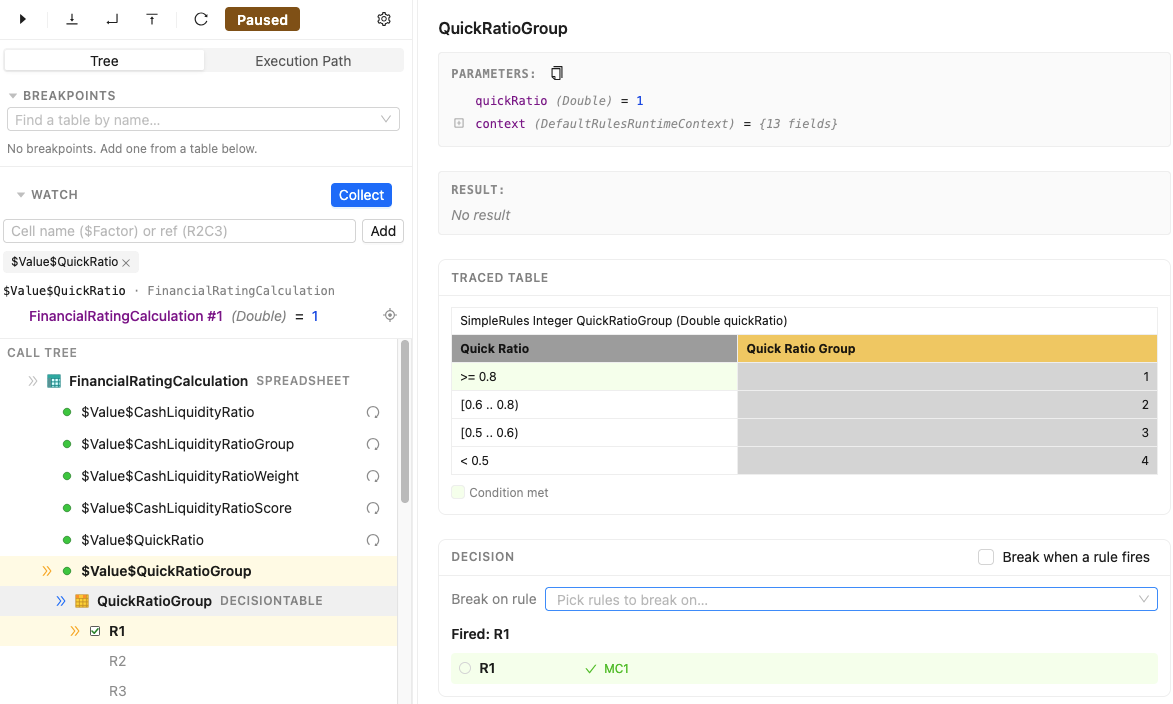
Table Creation and Copying in React
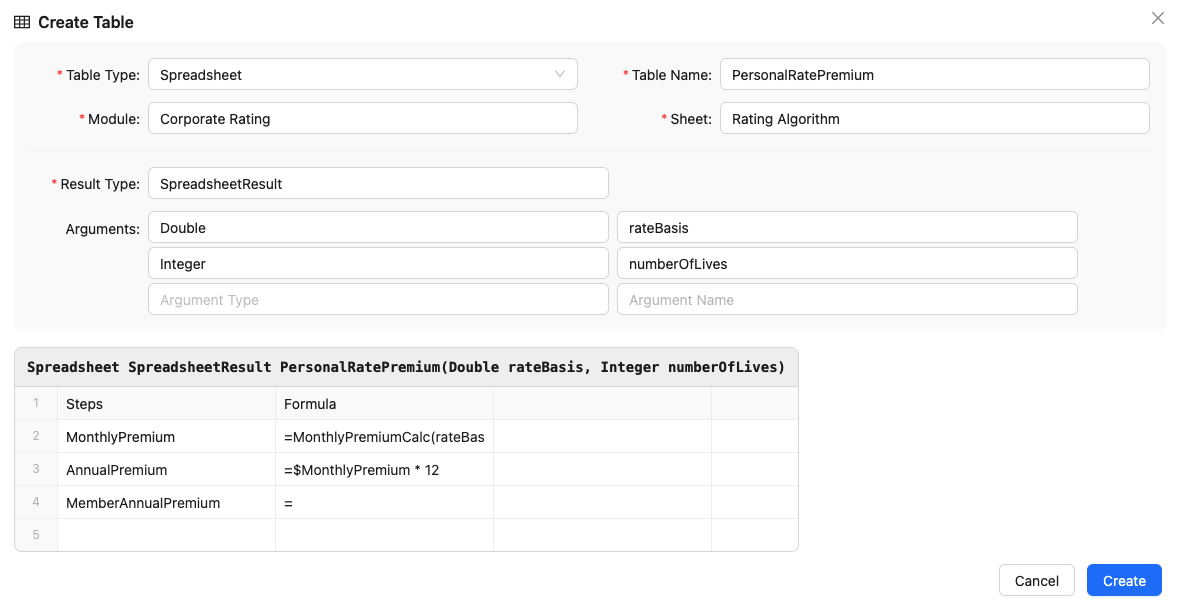
The table creation and copy wizards are replaced by React modals built around the header cell OpenL actually compiles. The dialog is a settings strip over the sheet the table will be written to: what it shows is exactly what is written to the workbook, and the name OpenL compiles is read back out of the generated header the same way the compiler reads it — never from the Name field.
Fifteen table types are supported, each with a body the dialog knows how to lay out: Datatype, Vocabulary, Constants,
Spreadsheet, Smart Rules, Simple Rules, Smart Lookup, Simple Lookup, Rules, Test, Run, Data, Environment, Properties
and Free Form. Lookup types build a two-dimensional matrix, values are entered through inputs typed to the column
they fill, and a Datatype’s optional Extends setting writes extends <parentType> into the header.
React Projects and Deployments
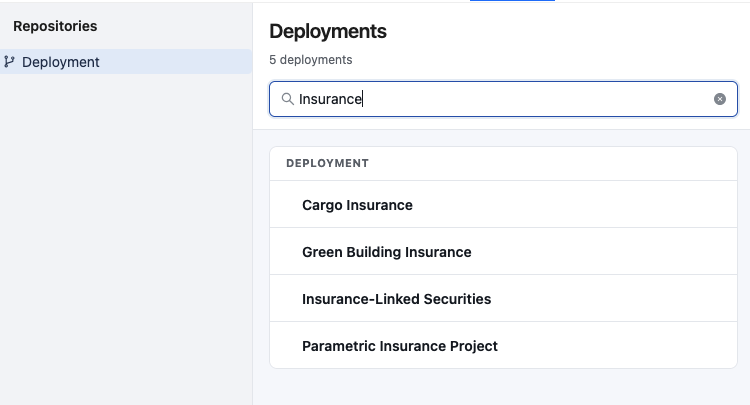
The Projects and Deployments tabs replace the legacy JSF Repository screens, which are removed along with the RichFaces upload dialogs, the jQuery loading panel and the JSF user-profile and confirmation popups.
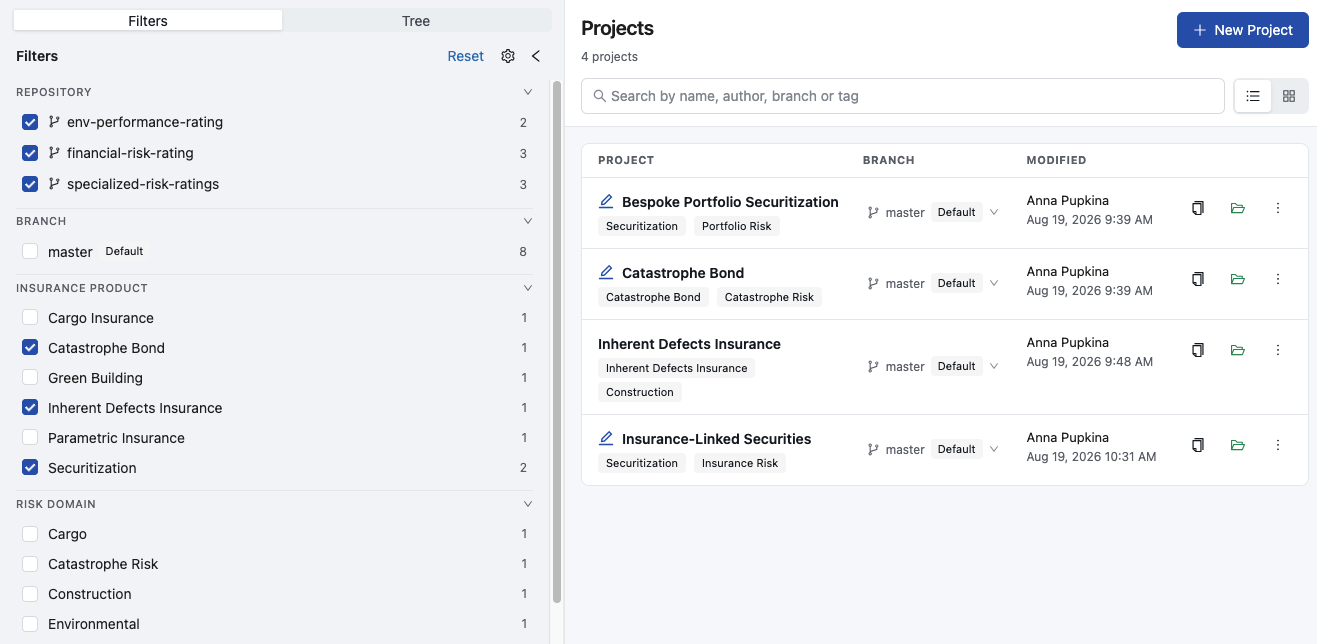
- Projects are grouped by repository on a first visit, with a filter rail that hides states no project is in.
- Search covers author and branch in addition to name and tag, and project actions collapse into an overflow menu instead of wrapping.
- A project can be created from a template, an archive, an existing project or a folder, with its name pre-filled from the source and its initial status selectable.
- Compilation state is shown as one consistent chip across every projects view, and the list loads only message counts rather than full compilation messages.
- Text files can be edited directly in the editor.
- Switching between React screens happens in place instead of reloading the page.
Project descriptors and tags are cached per revision, so the used-by column and the facet counts no longer re-read
every rules.xml on each request.
Projects in Any Branch
A project can be created and deleted in a non-default branch. Project discovery derives membership from Git trees, so a project is found when at least one readable branch contains it, and it stays one logical workspace item while its content, path and permissions differ per branch.
Each branch membership gets its own repository view, mapped path and file metadata, a deterministic home branch and a user-specific effective branch are selected per project, and authorization is applied separately to every branch membership. Default and protected branches are marked across the project screens and can be searched. Project-list and project-read requests no longer trigger repository-wide branch or history scans.
Live Project and Workspace Updates
Changes now reach open pages over the existing STOMP/WebSocket channel instead of waiting for a manual reload:
/topic/projects/changed— a broadcast ping when the design repository changes, including commits from other users and external Git pushes, debounced against merge and copy bursts./user/topic/workspace/changed— a per-user ping when a draft edit is made through any entry path, so an edit made by an MCP client or the editor flips the project to Editing at once./user/topic/workspace/projects/status— per-project compilation status for the subscribing user.
Broadcast topics carry no project data; clients re-read through REST under the usual access control. External pushes surface within the repository polling period.
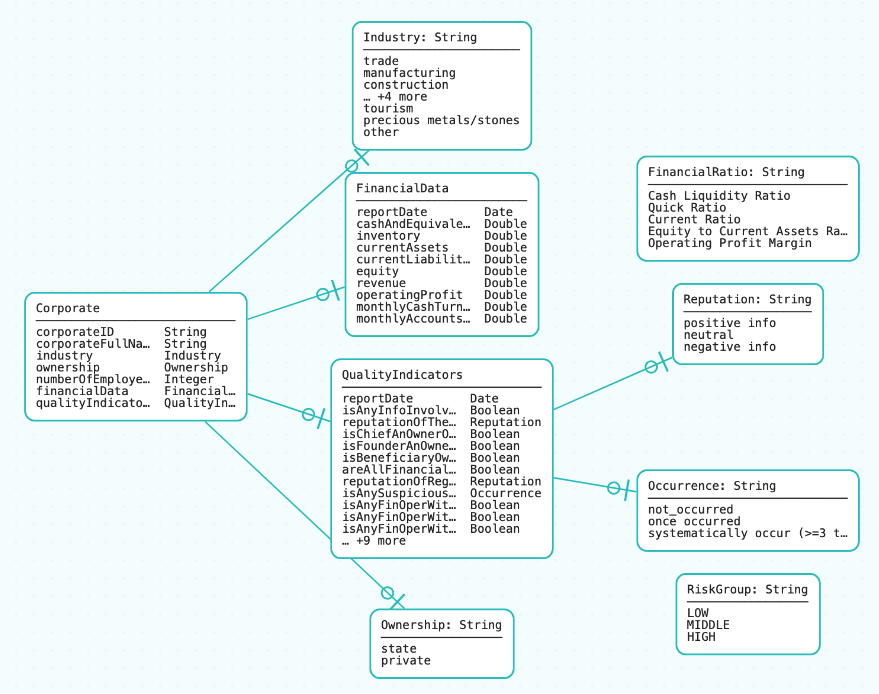
Data Model Visualization
The tables dependency graph draws the project’s data model as an ER diagram of typed entities, so datatypes and the relations between them can be read alongside the table dependencies they participate in.
Startup and Readiness Health Checks
OpenL Studio serves two unauthenticated endpoints for container orchestration:
GET /healthcheck/startup     -> 200 UP
GET /healthcheck/readiness   -> 200 READY
Any other path under /healthcheck stays behind the security filter. The Kubernetes example manifests use them for a
startup probe and an HTTP readiness probe, which removes the fixed initialDelaySeconds guesswork:
startupProbe:
  httpGet:
    path: /healthcheck/startup
    port: 8080
  periodSeconds: 10
  failureThreshold: 30
livenessProbe:
  tcpSocket:
    port: 8080
  periodSeconds: 15
  failureThreshold: 4
readinessProbe:
  httpGet:
    path: /healthcheck/readiness
    port: 8080
  periodSeconds: 10
  failureThreshold: 3
Improvements
OpenL Studio Administration
- Improved the Users and Groups management tables, and added search to both tabs.
- Added editing of user data in single user mode through the OpenL Studio UI.
- Added a prompt for the profile data a user is missing after authentication.
- Moved the active user badge to Last Login.
OpenL Studio User Interface
- Replaced the jQuery loading panel with the Ant Design spinner.
- Replaced the JSF confirmation popup with a React Ant Design dialog where data would otherwise be lost.
- Unified all OpenL Studio messages into one style, using Ant Design notifications.
- Replaced the RichFaces upload in the project and module update dialogs with the Ant Design upload.
- Moved the remaining editor toolbar dialogs to the React modals that already exist.
- Unified repository, branch and commit text sizing across the project screens, and replaced the monospace motif with the default Ant Design font.
Repository and Workspace
- Moved project metainfo out of project folders into a per-user workspace registry, reconciled on sign-in.
- Added an edit lock to the REST files API, which previously modified a project without taking one.
- Added atomic folder uploads and a
REPLACEconflict policy, so a folder upload is committed as one change. - Added a permission check for mapped content paths, so access is evaluated against the path a project is mapped to.
- Improved branch deletion to check every project a deleted branch would take with it.
- Extended Sync to be offered whenever the repository has a branch to merge into, and merge to offer every repository branch as a target on request.
- Improved merge to run on a project that is not opened instead of refusing it.
- Added a prompt before opening the dependencies of a project, naming the ones that are off its branch.
- Improved commit ordering so commits sharing a commit-time second are ordered by ancestry.
- Added the design revision a deployed project was built from to the deployment view.
- Added validation of the properties file name settings when
rules.xmlis written, so invalid settings are reported on save instead of surfacing later as a compilation failure.
REST API
- Added cell styles and row slicing to the raw table format.
- Added declaration of the modules an OpenAPI import generates.
- Improved the run result to name the executed table instead of the virtual suite.
Maven Plugin
- Migrated the Maven archetype to a
pom.xml-less structure, moving the simple project archetype to the top-level OpenL layout.
Bug Fixes
- Fixed projects being converted to
LOCALwhen access was revoked, when the original project was deleted on Azure Blob storage, or when the Git URL inwebstudio.propertieswas changed to an invalid one — the workspace refresh now keeps the repository link so every access check applies to the opened copy. - Fixed revoked access remaining ineffective: the first project listing after a revocation now evicts the opened copy — files, metainfo record and lock — from the user workspace.
- Fixed a deleted project or file reappearing after a page refresh.
- Fixed a project not being creatable under the name of a deleted project.
- Fixed a locked project not preventing another user from deleting its branch.
- Fixed the errors raised when deleting a local project — a missing workspace folder, and commit info being demanded for a project created in a Git repository.
- Fixed a project failing to open and a duplicate
LOCALproject being created when the commit carried no user. - Fixed an empty Modules list on the project page, caused by the
<modules>block being rewritten on Project Info and OpenAPI edits. - Fixed implicit modules being dropped when an Excel module was added or copied.
- Fixed the profiled Trace failing on large runs, and added tooltips to the trace controls.
- Fixed lost and incorrect parameter-field inputs in trace step details, a business-mode node switch flashing the root table, and the Basic Trace error path on failed runs.
- Fixed an NPE from
StaticResourcesServletwhen the OpenL Studio context was requested without a trailing slash. - Fixed the online user marker not appearing in the admin Users table in
multiandadmodes. - Fixed copy to clipboard failing on plain HTTP origins, where the Clipboard API is unavailable.
- Fixed the DEMO start script failing when its path contains spaces.
- Fixed URL-safe Base64 encoding of project and deployment identifiers, which broke redeployment when an identifier contained a slash.
- Fixed an NPE when creating a project from an OpenAPI file over REST.
- Fixed the table graph crashing because Prototype.js clobbered
Object.values. - Fixed the endless editor reload after the shell page expires.
- Fixed the sheet name mirrored from a table name exceeding Excel’s length limit.
Breaking Changes
This section summarizes changes that may require action before or after upgrading.
- Project deletion is permanent — The two-phase Archive, Undelete and Erase lifecycle is removed. Deleting a project removes it from the user’s workspace and from the current state of the Design repository, and for Git repositories the change is stored as an ordinary delete commit, so repository history keeps the deletion event. An open project is closed before removal. There is no Undelete action.
- Git commit messages are stored verbatim — The commit message template is removed, along with the
comment-templateproperty and its{user-message},{commit-type},{project-name}and{revision}placeholders. Git repositories store the entered comment directly as the commit message. The user message pattern and its hint remain configurable. - The legacy JSF Repository screens are removed — Bookmarks and deep links into the old Repository pages no longer resolve.
- Manual project import is removed — Importing a project from a repository is superseded by automatic project detection.
- The project descriptor size limit is 1 MB — A
rules.xmlabove 1 MB is refused, where the previous limit was 16 MB. - gRPC is no longer a dependency — The obsolete Studio AI search integration is removed together with its gRPC
dependency and
OpenL2TextUtils, which existed only for text-based search indexing.
Library Updates
Runtime Dependencies
| Library | Version |
|---|---|
| Jetty | 12.1.12 (from 12.1.10) |
| Netty | 4.2.17.Final (from 4.2.15.Final) |
| Jackson | 2.22.1 (from 2.22.0) |
| CXF | 4.1.8 (from 4.1.7) |
| Hibernate ORM | 6.6.55.Final (from 6.6.54.Final) |
| Hibernate Validator | 8.0.5.Final (from 8.0.4.Final) |
| Log4j | 2.26.1 (from 2.26.0) |
| OpenTelemetry | 2.30.0 (from 2.29.0) |
| OpenSAML | 5.2.3 (from 5.2.2) |
| Apache HttpClient5 | 5.6.4 (from 5.6.2) |
| Swagger Core | 2.2.53 (from 2.2.52) |
| Swagger Parser | 2.1.46 (from 2.1.45) |
| Groovy | 4.0.33 (from 4.0.32) |
| Guava | 33.7.1-jre (from 33.6.0-jre) |
| Bouncy Castle | 1.85.2 (from 1.84) |
| Byte Buddy | 1.18.11 (from 1.18.10) |
| Commons Codec | 1.22.1 (from 1.22.0) |
| Commons Collections | 4.6.0 (from 4.5.0) |
| JSpecify | 1.0.1 (from 1.0.0) |
| Micrometer | 1.17.0 (newly pinned) |
| lz4-java | 1.11.2 (newly pinned) |
| Oracle JDBC | 23.26.3.0.0 (from 23.26.2.0.0) |
| PostgreSQL JDBC | 42.7.13 (from 42.7.12) |
| MariaDB JDBC | 2.7.15 (from 2.7.14) |
Micrometer is now pinned explicitly to address a denial-of-service vulnerability (CVE-2026-40984) in the version Spring LDAP pulled in transitively. lz4-java is pinned to override the version Kafka brings in, addressing CVE-2026-59949. gRPC is no longer a dependency; it was removed with the AI search integration.
Test Dependencies
| Library | Version |
|---|---|
| JUnit | 6.1.3 (from 6.1.1) |
| XMLUnit | 2.13.0 (from 2.12.0) |
| Testcontainers Keycloak | 4.3.1 (from 4.2.1) |
| GreenMail | 2.1.12 (from 2.1.9) |
Build Tooling
| Tool | Version |
|---|---|
| Node.js | v24.18.0 (from v24.17.0) |
| npm | 12.0.1 (from 11.17.0) |
| NullAway | 0.13.8 (from 0.13.7) |
Migration Notes
Upgrading to OpenL Tablets 6.4.0 requires no database changes and no changes to rules content. Two behavior changes affect everyone who works with the Design repository — project deletion and Git commit messages — and several administrator-facing settings and screens are removed. Workspace metadata is migrated automatically on first start.
Rules Authors
- Deleting a project is permanent. The Archive, Undelete and Erase actions are gone, and so is the Hide deleted projects filter. Deleting a project removes it from your workspace and from the current state of the Design repository. For Git repositories the deletion is stored as an ordinary delete commit, so the project can still be recovered from repository history by an administrator, but there is no Undelete action in OpenL Studio. Confirm any project you were keeping in the archived state before upgrading. A new project may now reuse the name of a deleted one, which the archived state previously blocked.
- Trace opens in the business view. Existing traces behave the same, but the screen now leads with a view aimed at rule authors; the previous debugger chrome is behind the Advanced switch. No configuration is involved.
- The Repository screens are now the React Projects and Deployments tabs. The legacy JSF pages are removed; replace any bookmarks or deep links into them. The actions you used are all present, with project actions collected into an overflow menu.
- Manual project import is removed. Projects in the Design repository are detected automatically, so there is no import step to perform.
- Existing projects, tables and tests are otherwise unaffected. No re-save or re-compile is required.
Administrators
-
Remove the Git commit message template. The
comment-templateproperty is no longer read, and its{user-message},{commit-type},{project-name}and{revision}placeholders no longer exist. Delete the following lines from your properties file if present:repo-git.comment-template = {user-message} Type: {commit-type}. repo-default.design.comment-template = {user-message} Type: {commit-type}.Git repositories now store the comment the user entered as the commit message, unchanged. If your tooling parses commit messages for the
Type:envelope, update it before upgrading — commits created by 6.4.0 will not carry it. The User message pattern and Invalid user message hint settings are unchanged and still validate what a user may enter. -
Review the per-operation comment templates. The Archive project, Restore project and Erase project templates are removed and replaced by a single Delete project template. Save project, Create project, Copy project and Restore from old version are unchanged.
-
Switch Kubernetes probes to the health check endpoints. OpenL Studio serves
GET /healthcheck/startupandGET /healthcheck/readinesswithout authentication. Using them removes the fixedinitialDelaySecondsguesswork from the manifests:startupProbe: httpGet: path: /healthcheck/startup port: 8080 periodSeconds: 10 failureThreshold: 30 livenessProbe: tcpSocket: port: 8080 periodSeconds: 15 failureThreshold: 4 readinessProbe: httpGet: path: /healthcheck/readiness port: 8080 periodSeconds: 10 failureThreshold: 3Any other path under
/healthcheckremains behind the security filter and redirects to the login page. -
Check project descriptors against the 1 MB limit. A
rules.xmllarger than 1 MB is refused, where the previous limit was 16 MB. A descriptor of that size is almost always generated content; split or trim it before upgrading. -
Workspace metadata migrates on first start. The
.studioPropsmigration always runs so local workspaces survive the upgrade, and the single-user workspace is moved to the resolved user name. No manual step is required; allow for the migration on the first start after the upgrade. - Project permissions are evaluated per branch. Authorization is applied separately to each branch membership of a project, and against the path a project is mapped to. Review access control lists for repositories where a project exists on several branches with different paths.
- Revoking access now takes effect immediately. A revoked project is no longer converted to a local copy that the user keeps working in; the first project listing after the revocation evicts the opened copy — files, metainfo record and lock — from that user’s workspace. Any unsaved work the user had in a revoked project is discarded, so communicate revocations that matter.
Developers
- The AI and gRPC search integration is removed. The obsolete Studio AI search integration is gone, gRPC is no
longer a dependency of OpenL Tablets, and
OpenL2TextUtils— used only for text-based search indexing — is removed. If your build inherited gRPC transitively from OpenL, declare it yourself. If your code calledOpenL2TextUtils, inline the conversion you need. - The Trace REST API is new. The interactive debugger is driven by
/rest/projects/{projectId}/trace, withPOST /step,POST /resume,POST /pause,PUT /breakpoints,GET /watchesand frame-scoped reads. The endpoints are additive; existing run and test endpoints are unchanged. - Subscribe to the change topics for live updates. The STOMP endpoint is unchanged (
/web/wsfor session auth,/rest/wsfor Basic, PAT or Bearer). Three topics now carry change notifications:/topic/projects/changed(broadcast ping),/user/topic/workspace/changed(per-user draft ping) and/user/topic/workspace/projects/status(per-project compilation status). Broadcast topics carry no project data, so clients must re-read through REST, where access control applies. - Uploaded content is verified for completeness. Workbooks and archives that lost their tail are refused by the
upload APIs with a
400response rather than being stored. Clients that streamed partial content and relied on it being accepted will now see the failure at upload time. - The table creation API is unchanged, and the rebuilt Create Table modal submits through it. Table copying now runs on the server by table id instead of re-posting the table content.
Environment and Dependency Changes
- No Java version change. No SQL migration is required.
- Micrometer (
1.17.0) and lz4-java (1.11.2) are now pinned explicitly to address CVE-2026-40984 and CVE-2026-59949. If your build overrides these transitive dependencies, align your overrides with these versions. - Jetty moves to
12.1.12and Netty to4.2.17.Final. Deployments that embed OpenL Studio in their own servlet container should confirm compatibility with these versions. - The frontend toolchain moves to Node.js
v24.18.0and npm12.0.1. This affects only builds from source.
Testing Recommendations
After upgrading, verify in a non-production environment:
- A project deletion, and that the deletion appears in the Git history of the Design repository.
- A commit made from OpenL Studio, confirming the stored Git message is exactly what was entered.
- A project that exists on more than one branch, confirming it is discovered and that permissions apply per branch.
- An upload of a workbook and of an archive, confirming both are accepted and that a truncated file is refused.
- The startup and readiness endpoints, if your deployment is orchestrated.