OpenL Tablets 6.2.0 Release Notes
Contents
OpenL Tablets 6.2.0 introduces cloud-friendly structured logging for the Docker images and a rebuilt, interactive table dependency graph in OpenL Studio. It also extends the REST API, improves the OpenL Maven Plugin, and resolves several critical memory leaks and a multi-module deployment regression.
This release includes breaking changes that require review before upgrading, most notably the default Docker log output format.
New Features
Structured JSON Logging for Docker Images
The Docker images now route all logging — the Jetty server, the web application, and java.util.logging-based
libraries — through a single Log4j2 logging system whose output format is selected with the LOGGING_FORMAT environment
variable. The default is ECS (Elastic Common Schema) JSON on stdout, which log aggregation tools such as Elastic,
Splunk, and Datadog can parse, index, and query by field.
ecs(default) — cloud-friendly logs in Elastic Common Schema JSON format on stdout.plain— human-readable text, the same layout bundled in the.war.none— discard all log events; nothing is written to the console.otel— mute the Log4j2 console and let the OpenTelemetry agent capture log events and write them to stdout as OTLP JSON.
The root log level is set with LOGGING_LEVEL_ROOT (default INFO). The ECS layout enriches each event with service
metadata derived from the environment:
appender.console.layout.eventTemplateUri = classpath:EcsLayout.json
appender.console.layout.svc.value = ${env:OTEL_SERVICE_NAME:-OpenL}
appender.console.layout.host.value = ${env:HOSTNAME:-unknown}
appender.console.layout.ver.value = ${env:SERVICE_VERSION:-0}
appender.console.layout.env.value = ${env:ENVIRONMENT:-production}
rootLogger.level = ${env:LOGGING_LEVEL_ROOT:-INFO}
This applies only inside the Docker image; non-Docker .war deployments keep their bundled plain-text configuration.
Interactive Table Dependency Graph in OpenL Studio
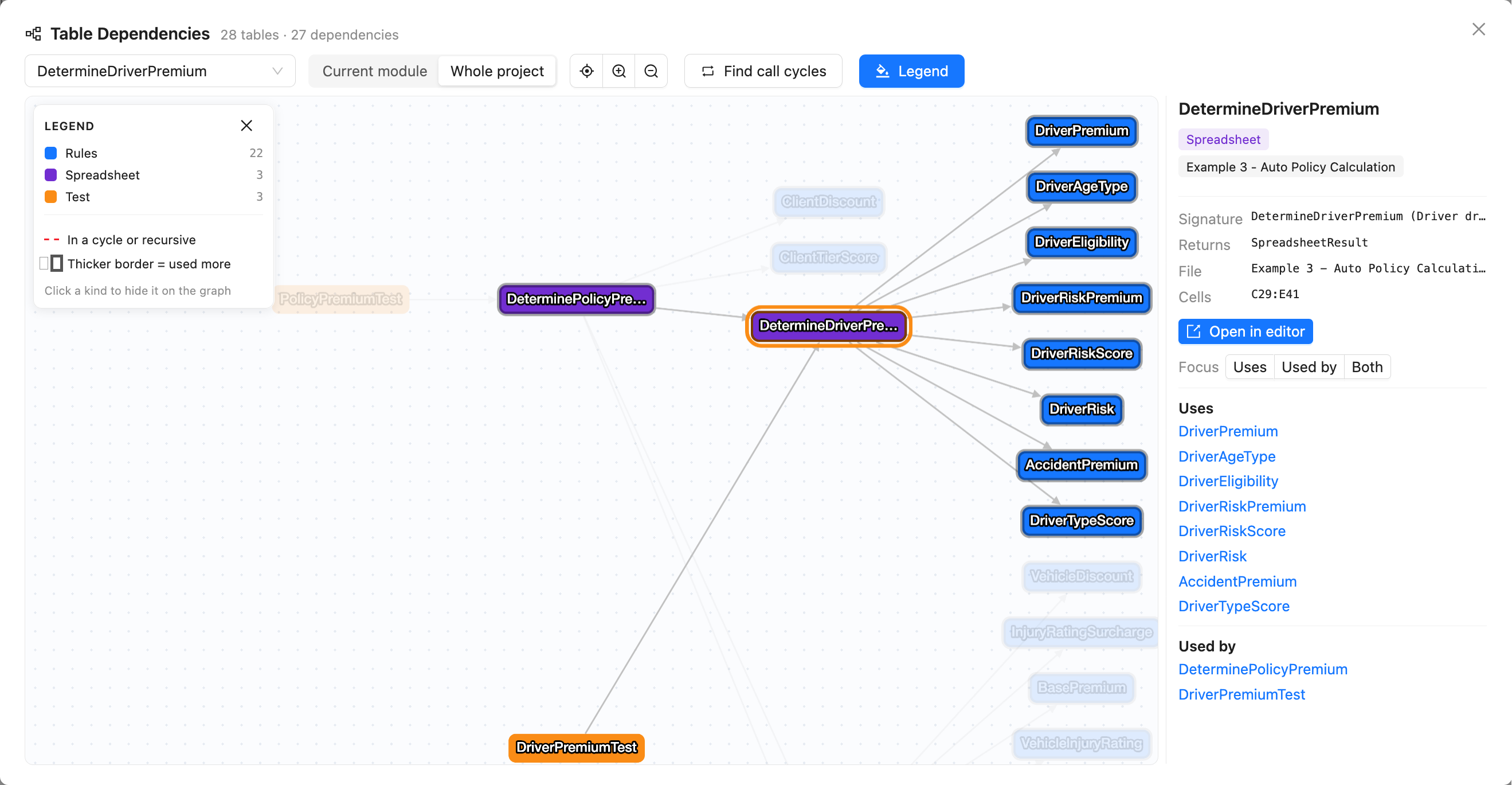
OpenL Studio replaces the legacy applet-style dependency view with a supported, interactive table dependency graph, opened from the editor’s More → Table Dependencies. The graph is backed by a documented REST API and renders a module’s tables and the dependencies between them.
- An in-window scope selector switches between Current module and Whole project and rebuilds the graph.
- Call cycles (
A → B → C → A) are detected and highlighted, and recursive tables are drawn as self-loops. - Dispatcher nodes for overloaded or versioned methods list the business dimensions (state, dates, LOB, and so on) that select each version.
- Table-name search, a legend that decodes and filters node kinds, a summary panel (signature, file, cells, properties), and Open in editor for tables in the active project round out the view.
The graph is served by two endpoints under the experimental Projects (BETA) API:
GET /rest/projects/{projectId}/tables/graph
GET /rest/projects/{projectId}/tables/{tableId}/graph
The single-table endpoint accepts a direction (DEPENDENCIES, DEPENDENTS, or BOTH) and an optional depth to
bound traversal.
Improvements
OpenL Studio
- Added a REST API to delete a project branch,
DELETE /rest/projects/{projectId}/branches/{branch}, returning204 No Content. The repository’s main branch cannot be deleted, a project currently open on the branch is closed first, and deleting a protected branch requiresforce=truefor eligible users. The branch-delete dialog was reimplemented in React. - Removed the redundant Open button from the rules editor. Its earlier behavior of launching Microsoft Excel was discontinued in a previous release, and the Export module button already provides the equivalent action.
- Stabilized the generated OpenAPI document so it serializes deterministically: tags, schemas, paths, and map entries
are ordered,
@Sizeon collections and maps is emitted asminItems/maxItemsandminProperties/maxProperties, and the implicitAccept,Content-Type, andAuthorizationheader parameters are omitted.
OpenL Maven Plugin
- Attached the jar built from the project
classesfolder as a supplementary artifact with theclassesclassifier (the same convention asmaven-war-plugin), built with the deterministic name${finalName}-classes.jar. Other Maven modules can now depend on the compiled classes through standard coordinates, andinstall/deploypublish the artifact automatically. - Enhanced the
openl:migratemethod-filter migrator to derive<exposed-methods>include patterns from legacy<method-filter>regular expressions instead of enumerating every method. A name-prefix regexp such as.+ _api_.+\(.+\)becomes the glob_api_*, patterns fully covered by a broader glob are dropped, and only patterns that actually match the built project’s methods are kept.
Bug Fixes
- Fixed web-application class-loader and worker-thread leaks reported by the servlet container on undeploy and shutdown when a Git or Azure repository is in use. Parallel rule evaluation now runs on an unbounded virtual-thread-per-task executor that is shut down with the application context, and the JGit background worker thread and message-bundle cache are released on context close.
- Fixed a memory and file-descriptor leak where input streams opened over deployment archives stayed open for the data source’s lifetime. Deployment resources are now read lazily and closed by the caller, and temporary jars extracted from nested classpath archives are deleted when the class loader is released rather than at JVM exit.
- Fixed multi-module OpenL Maven builds failing at runtime with
There is no implementation in rules for interface
method ...
when an API project depends on another OpenL project and pre-generates its datatype classes. The project’s generated-classes jar is no longer embedded in the archive for that project shape, so a datatype resolves to a single class instead of two conflicting copies. - Fixed OpenL Studio freezing and projects disappearing from the Editor tab when switching between modules quickly. A deadlock between compilation-status notification and module loading left the loading indicator spinning; status updates are now delivered off the compilation lock, and rapid navigation is ignored until the current module finishes loading.
- Fixed appending rows to Spreadsheet tables through the tables REST API and the MCP
openl_append_tabletool. ThePOST /rest/projects/{projectId}/tables/{tableId}/linesendpoint now accepts theSpreadsheettable type and rejects malformed appends — rows wider than the table, or mismatched or empty spreadsheet rows and cells — with400 Bad Request. - Fixed the JVM not exiting after Tomcat stop. The STOMP WebSocket heartbeat scheduler was an unmanaged, non-daemon thread that outlived the Spring context; it is now a Spring-managed daemon bean shut down on context close.
- Fixed an
AccessDeniedException: /proc/tty/driverwhen opening a project whoserules.xmlhas a blank or missing<name>. Such projects now fall back to their folder name, and repository path resolution rejects any path that escapes the repository root.
Breaking Changes
This section summarizes changes that may require action before or after upgrading.
- Docker log output format — The default log output of the Docker images changed from plain text to ECS JSON on
stdout. Set
LOGGING_FORMAT=plainto restore the previous human-readable format. The newLOGGING_LEVEL_ROOTcontrols the root level (defaultINFO). Non-Docker.wardeployments are unaffected. - OpenL Maven Plugin generated-classes jar — For a project that both depends on other OpenL projects and runs the
generategoal,openl:packageno longer embeds the project’s generated-classes jar in the archive by default. Use the newincludeGeneratedClasspathJarparameter to force the previous behavior. All other projects are unaffected. - Rules editor Open button — The Open (open-in-Excel) button and its
/action/launchservlet were removed from OpenL Studio. Use the Export module button instead. - OpenAPI document — The generated OpenAPI specification changed shape: deterministic ordering, omitted implicit
header parameters, and
minItems/maxItemsfor sized collections. Regenerate clients pinned to the previous output.
Library Updates
Runtime Dependencies
| Library | Version |
|---|---|
| Spring Framework | 6.2.19 (from 6.2.18) |
| Spring Boot | 3.5.15 (from 3.5.14) |
| Spring Integration | 6.5.9 (from 6.5.8) |
| Spring Security | 6.5.11 (from 6.5.10) |
| Hibernate ORM | 6.6.53.Final (from 6.6.52.Final) |
| Hibernate Validator | 8.0.4.Final (from 8.0.3.Final) |
| HikariCP | 7.1.0 (from 7.0.2) |
| OpenTelemetry | 2.29.0 (from 2.28.1) |
| CXF | 4.1.7 (from 4.1.6) |
| gRPC | 1.82.0 (from 1.81.0) |
| Swagger Core | 2.2.52 (from 2.2.50) |
| Swagger Parser | 2.1.44 (from 2.1.43) |
| Azure Blob Storage SDK | 12.35.0 (from 12.34.0) |
| Log4j JSON Template Layout | 2.26.0 (New) |
Test Dependencies
| Library | Version |
|---|---|
| S3Mock | 5.1.0 (from 5.0.0) |
| MariaDB Driver | 2.7.14 (from 2.7.13) |
| GreenMail | 2.1.9 (from 2.1.8) |