OpenL Tablets 6.1.0 Release Notes
Contents
OpenL Tablets 6.1.0 expands the OpenL Studio REST API for automation and AI-agent tooling, adds rule tracing and execution over REST, simplifies OpenL Maven projects, and refines access control and OpenL Rule Services.
This release also includes breaking changes that require review before upgrading.
New Features
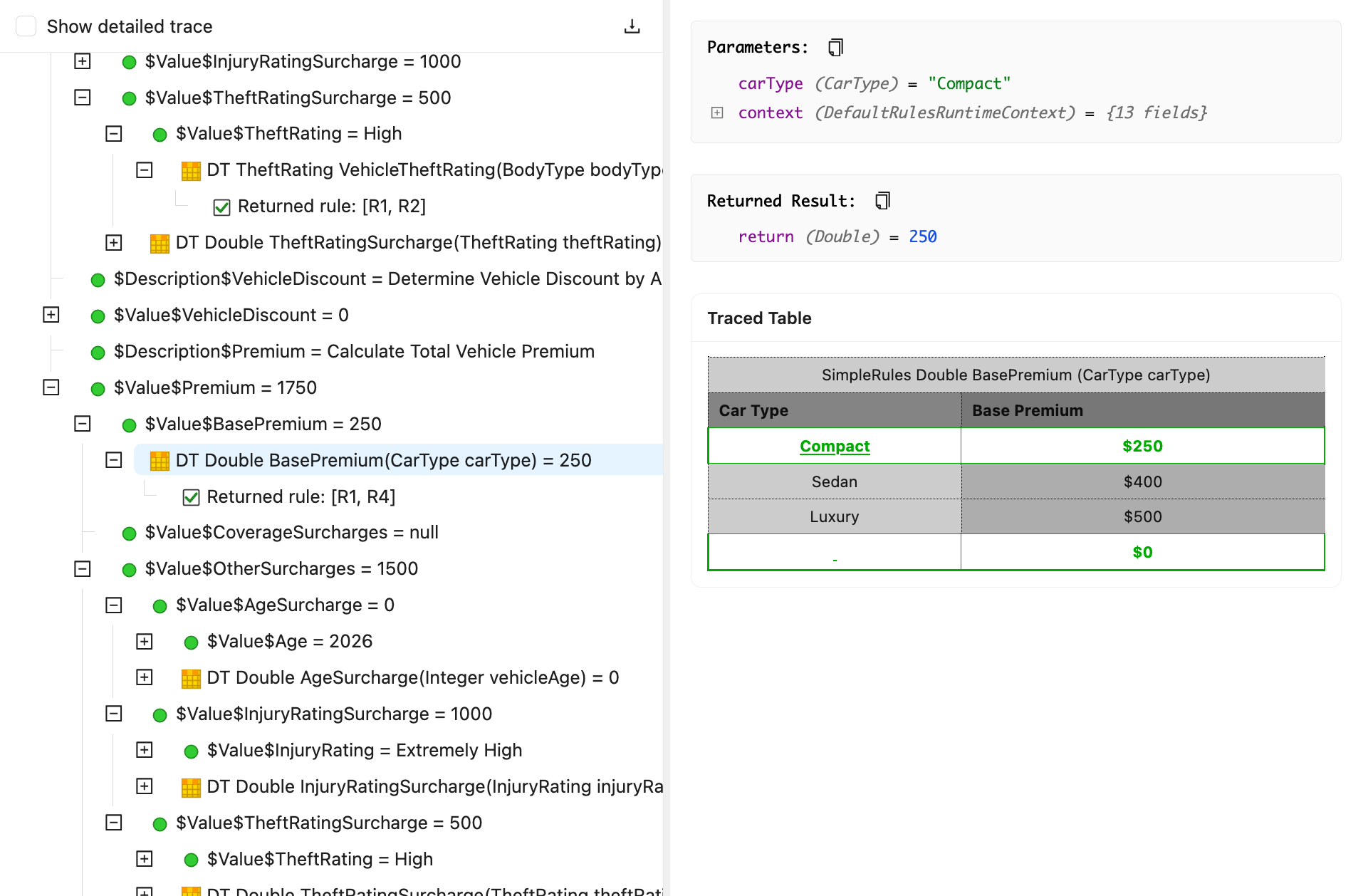
Rule Tracing API and UI in OpenL Studio
OpenL Studio gains a REST-first tracing capability for debugging and analyzing rule execution, replacing the legacy trace view. A trace starts asynchronously and reports progress over a STOMP WebSocket channel, so the UI stays responsive even for large decision tables and spreadsheets.
The hierarchical execution tree loads lazily — root nodes first, children on demand — and complex parameter values are fetched only when expanded. For any node you can inspect its parameters, context, result, and errors, view the executed table as an HTML fragment with execution-flow highlighting, and stream the full trace to a downloadable text file.
The REST-first design serves both the Studio UI and external automation, including AI-agent (MCP) tooling.
POST /rest/projects/{projectId}/trace— start a trace fortableId, with optionaltestRangesand a JSON body ofruntimeContextandparams; returns202 AcceptedDELETE /rest/projects/{projectId}/trace— cancel the running traceGET /rest/projects/{projectId}/trace/nodes— root nodes, or the children of a node via theidparameterGET /rest/projects/{projectId}/trace/nodes/{nodeId}— full node detailsGET /rest/projects/{projectId}/trace/parameters/{parameterId}— the value of a lazily loaded parameterGET /rest/projects/{projectId}/trace/nodes/{nodeId}/table— the executed table as an HTML fragment (showFormulastoggles formulas)GET /rest/projects/{projectId}/trace/export— the full trace as a plain-text file
Execute Rules with Test Data over REST
A new endpoint runs a specified rule table with supplied input data and returns the execution result together with any errors, enabling automated testing and AI-agent (MCP) scenarios. Execution follows an asynchronous start-then-poll pattern, and the completed result can be retrieved as JSON or downloaded as an XLSX workbook through content negotiation.
POST /rest/projects/{projectId}/run?tableId=...— start execution with a JSON input body; returns202 AcceptedGET /rest/projects/{projectId}/run/result— fetch the completed result; returns200 OKas JSON, or as XLSX when requested withAccept: application/vnd.openxmlformats-officedocument.spreadsheetml.sheetDELETE /rest/projects/{projectId}/run— clear the run; returns204 No Content
pom.xml-less OpenL Maven Projects
A folder containing only rules.xml and the standard OpenL layout can now act as a Maven module, removing the
per-project pom.xml duplication in repositories that host many OpenL projects sharing the same group, version, and
build configuration.
A single anchor pom.xml at the repository root declares openl-maven-plugin with <extensions>true</extensions>. The
plugin then discovers every rules.xml folder beneath the anchor, derives each project’s coordinates from its path, and
builds a .zip artifact per project — with no per-project pom.xml. The anchor is wired as the parent so projects
inherit build configuration, plugin and dependency management, properties, distribution management, and repositories.
Cross-project dependencies are resolved through the reactor, and classic pom.xml-based OpenL projects continue to work
unchanged in the same build.
<project>
    <modelVersion>4.0.0</modelVersion>
    <groupId>com.example</groupId>
    <artifactId>my-rules</artifactId>
    <version>1.0.0-SNAPSHOT</version>
    <packaging>pom</packaging>

    <build>
        <plugins>
            <plugin>
                <groupId>org.openl.rules</groupId>
                <artifactId>openl-maven-plugin</artifactId>
                <version>${openl.version}</version>
                <extensions>true</extensions>
            </plugin>
        </plugins>
    </build>
</project>
The feature adds goals bound to the openl lifecycle — openl:sync-versions and openl:prepare-pom (validate),
openl:prepare-bom (package), and openl:verify (verify) — and an aggregator goal openl:pomless that converts
existing pom.xml-based projects to the pom-less form. Conversion runs as a dry run by default and applies only with
-Dopenl.pomless.dryRun=false.
New migrate Goal for the OpenL Maven Plugin
The OpenL Maven Plugin adds a migrate goal that updates a project’s configuration and scripts to the conventions of
the current OpenL Tablets version.
mvn openl:migrate
The goal removes obsolete and default entries from rules.xml and rules-deploy.xml, renames the <method-filter>
element to <exposed-methods>, replaces the deprecated interceptingTemplateClassName with
annotationTemplateClassName, and rewrites javax.* imports to jakarta.* in Groovy scripts. Each migration step is
recorded as a separate commit, and -Dopenl.migrate.dryRun=true previews the changes without writing them.
Improvements
OpenL Studio REST API
- Added a files REST API to read, upload, download, copy, move, and search files inside projects (
/rest/projects/{projectId}/files/{*path}) and repository roots (/rest/repos/{repo-name}/files/{*path}), with branch- and version-aware reads, multi-file commits, and ZIP folder upload and download. - Added a project status REST API,
GET /rest/projects/{projectId}/status, and a STOMP WebSocket channel,/topic/projects/{projectId}/branches/{branch}/status, that push compilation status so the editor tracks compile progress without polling. - Added response field projection through the
fieldsquery parameter — for examplefields=id,name,modules(id,name)— to return only the requested fields, including nested objects and collection elements. - Improved project identity so
/rest/projects/{identity}endpoints accept either a project ID or a project name, returning a409 Conflictwith the candidate IDs when a name is ambiguous.
OpenL Studio
- Enhanced the test Run menu with All, Select, and Use the Range modes; Select lets you choose individual test cases and is available for tables with at most 20 test cases.
- Replaced the regular-expression method-filter syntax with simple glob patterns (
*for any sequence of characters,?for one), renamed Interface Methods to Exposed Methods, and added a Migrate Method Filters action that converts existing filters. - Added a Manager-only option to bypass protected-branch restrictions when merging in Studio, controlled by
security.allow-bypass-protected-branches(defaultfalse) together with a per-requestforceflag; the bypass honors the Manager role’s project- or repository-level scope. - Removed automatic group assignment in Multi-User mode so access is governed entirely by ACL roles.
- Made ACL permission grants concurrency-safe, eliminating intermittent
500errors when permissions for the same principal were granted on several projects at once.
OpenL Rule Services
- Sanitized API error responses so validation errors return clear messages such as
Invalid date formatandUnknown field '<field>'while no longer exposing Java class names, package paths, or framework internals; unexpected errors return a generic message. - Added support for loading multiple OpenAPI configuration files:
openapi-configuration.jsonis applied first, then anyopenapi-configuration-*.jsonfiles in filename order, each overriding the previous one.
OpenL Maven Plugin
- Generate the deployment artifact automatically when a project has dependent OpenL projects, replacing each
dependency’s
rules-deploy.xmlwith an empty-publishers stub so the dependency is not published twice; thedeploymentPackageparameter is deprecated and has no effect. - Split the
tests/folder into a separate artifact with thetestsclassifier so test workbooks are not shipped to OpenL Rule Services deployments, reducing deploy-time parsing, memory, and archive size.
OpenL Core
- Added defaults for
rules.xmltags so a minimal configuration can be used:<name>defaults to the project folder name,<modules>to workbooks underrules/**/*.xlsxandtests/**/*.xlsx, and<classpath>togroovy/andlib/*.jar. - Added support for building and running on Java 25 and Java 26; Java 21 remains the minimum supported version.
Bug Fixes
- Fixed missing compile-time validation of vocabulary (domain) values: literals outside a vocabulary passed to rule, datatype-constructor, and spreadsheet-step parameters now report a compile error instead of failing at runtime.
- Fixed smart lookup tables losing their structure when column descriptions contained merged cells; empty subheaders are now preserved through the REST read-and-write round trip.
- Fixed silent save failures when two users edited the same branch: saving an outdated revision now opens the merge-conflict resolution dialog instead of doing nothing.
- Fixed garbled, overflowing characters shown in the Sync updates popup for closed projects.
- Fixed the rules-tree Default Order not refreshing when the user setting changed; the chosen order now takes effect immediately.
- Fixed the tables REST API corrupting smart rules that use the
Collectkeyword, and added per-table compilation messages to the response. - Fixed the non-functional Save Templates and Fill Tags for Project buttons on the administration Tags page.
- Fixed merges into protected branches being allowed during Sync; the action is now blocked with a warning.
- Fixed inconsistent and incorrect results from the
mod,quotient,remainder, andfloorDivfunctions across numeric types and for large values. - Removed a redundant second initialization of the OpenL engine that ran on every rules instantiation because of the TBasic (Algorithm table) bootstrap.
- Fixed
GET /rest/projects/{projectId}/tables?unpaged=truereturning only one module’s tables for local multi-module projects instead of all of them. - Fixed
GET /rest/projects/{projectId}/tables/{tableId}returning"args": [ {} ]for argument-less tables instead of an empty array. - Fixed an HTTP
500fromGET /rest/projects/{projectId}/tests/summarywhen a test produced comparison results but defined no result columns. - Fixed the date parser dropping an explicit timezone offset when the request date included milliseconds, so a value
such as
2026-06-03T10:00:00.000+09:00is no longer interpreted in the server’s local time.
Deprecations
- The
deploymentPackageparameter of the OpenL Maven Plugin is deprecated for removal and now has no effect; a warning is logged when it is set. Deployment artifacts are generated automatically. - The
<method-filter>element inrules.xmlis superseded by the project-level<exposed-methods>element.
Breaking Changes
This section summarizes changes that may require action before or after upgrading.
- Method filter syntax — Include and exclude method filters now use glob patterns instead of regular expressions and move from module level to a project-level Exposed Methods list. Existing regular-expression filters work as before.
- Vocabulary value validation — Calls that pass literals outside a vocabulary (domain) now fail to compile rather
than at runtime, so projects that previously compiled with such values report errors. The
Datatype Name<Type[]>form — arrays as a vocabulary target type — is no longer valid. - OpenL Rule Services error responses — Error responses no longer include Java types, package names, or framework internals. Clients that parsed those details must adapt to the new generic, field-level messages.
- OpenL Maven Plugin deployment — The
deploymentPackageparameter no longer has any effect and deployment artifacts are generated automatically. - OpenL Maven Plugin tests folder —
mvn packagenow excludestests/from the main artifact and produces a separate-testsartifact by default. - Groups in Multi-User mode — Multi-User mode no longer assigns groups; access is configured through ACL roles instead.
Library Updates
Runtime Dependencies
| Library | Version |
|---|---|
| Spring Framework | 6.2.18 (from 6.2.16) |
| Spring Boot | 3.5.14 (from 3.5.11) |
| Spring Integration | 6.5.8 (from 6.5.7) |
| Spring Security | 6.5.10 (from 6.5.8) |
| Hibernate ORM | 6.6.52.Final (from 6.6.43.Final) |
| OpenSAML | 5.2.2 (from 5.2.0) |
| Nimbus JOSE + JWT | 10.9.1 (from 10.8) |
| ASM | 9.10.1 (from 9.9.1) |
| Byte Buddy | 1.18.10 (from 1.18.5) |
| Kafka Clients | 4.3.0 (from 4.2.0) |
| OpenTelemetry | 2.28.1 (from 2.25.0) |
| Jackson | 2.22.0 (from 2.21.1) |
| CXF | 4.1.6 (from 4.1.5) |
| gRPC | 1.81.0 (from 1.79.0) |
| Swagger Core | 2.2.50 (from 2.2.43) |
| Swagger Parser | 2.1.43 (from 2.1.38) |
| Log4j | 2.26.0 (from 2.25.3) |
| SLF4J | 2.0.18 (from 2.0.17) |
| Jetty | 12.1.10 (from 12.1.6) |
| Maven API | 3.9.16 (from 3.9.12) |
| Maven SCM | 2.2.1 (New) |
| Plexus Utils | 4.0.3 (from 4.0.2) |
| Amazon AwsSDK | 2.45.0 (from 2.41.34) |
| Azure Blob Storage SDK | 12.34.0 (from 12.33.2) |
| Netty | 4.2.15.Final (from 4.2.10.Final) |
| Jaxb Runtime | 4.0.9 (from 4.0.6) |
| Commons Codec | 1.22.0 (from 1.21.0) |
| Commons IO | 2.22.0 (from 2.21.0) |
| Gson | 2.14.0 (from 2.13.2) |
| BouncyCastle | 1.84 (from 1.83) |
| Groovy | 4.0.32 (from 4.0.30) |
| Guava | 33.6.0-jre (from 33.5.0-jre) |
| Spring AI | deleted |
| MCP SDK | deleted |
Test Dependencies
| Library | Version |
|---|---|
| JUnit | 6.1.0 (from 6.0.3) |
| Mockito | 5.23.0 (from 5.21.0) |
| XMLUnit | 2.12.0 (from 2.11.0) |
| Testcontainers | 2.0.5 (from 2.0.3) |
| Testcontainers Keycloak | 4.2.1 (from 4.1.1) |
| S3Mock | 5.0.0 (New) |
| Oracle OJDBC11 | 23.26.2.0.0 (from 23.26.1.0.0) |
| PostgreSQL Driver | 42.7.11 (from 42.7.10) |
| MSSQL Driver | 13.4.0.jre11 (from 13.2.1.jre11) |
| MinIO | deleted |